Everything Apple

Tuesday, 5 June 2018

Scooter startup Lime is reportedly raising $250M led by Uber investor GV

It’s scooters all the way down this morning, with Lime also reportedly raising $250 million in a funding this morning after a new Delaware filing this morning indicated that competitor Bird authorized the sale of up to $200 million in shares.

GV (formerly Google Ventures) is leading this round, according to the report by Axios, as the massive land grab for a stake in the scooter wars continues to heat up — whether that’s funding or actual scooters piling up on the sidewalk. Both companies have faced pushback from some city regulators (probably on the basis of tripping over them and falling on your face), but it still means the venture community is still salivating over potentially the next major mode of metropolitan transportation. Most venture investors in the Valley argue scooters make sense for short trips throughout areas that are just too far to be considered a trek, but too close that it would be a waste of time and money to call a ride share like Uber or Lyft.

Given that Uber exposed a massive hole for easier transportation in major metropolitan areas — and potentially replacing cars in those areas — getting into the next big transportation revolution is more than tempting enough for firms like GV (which is also an investor in Uber). Lime was previously reported to be seeking up to $500 million in funding and was taking meetings with some major firms in Silicon Valley over the past few weeks. It might not get that, but a $250 million influx might be plenty to try to continue to ramp up its business and get more rides on board. Axios is reporting that Lime has told investors users have taken 4.2 million rides and each scooter gets 8 to 12 rides per day.

Still, while it’s not $500 million, there’s plenty of interest in the on-demand scooter business — challenges of keeping them charged and intact included — that Bird has authorized the sale of up to $200 million in new shares at a $1 billion valuation just months after its previous round. So it might not be surprising if this, too, ends up as kind of a rolling process where Lime eventually gets all the capital it sought.

Scooter startup Bird has authorized sale of $200M in shares in latest funding round

Bird, the scooter startup whose scooters you might have seen fallen over on the sidewalk in a major metro area, has authorized a new $200 million round of funding that could value the startup at around $1 billion post-money, according to a certificate of incorporation filed in Delaware.

The latest Bird round has been pretty widely reported, suggesting that the company is raising $150 million at a $1 billion valuation. That, too, comes amid a big effort by competitor Lime to raise a big funding round. These documents indicate that the company has authorized the sale of those shares, though it may not fully fill out the round. The certificate of incorporation document was provided be Lagniappe Labs, creator of the Prime Unicorn Index.

The document indicates that Bird has authorized the sale of 31.5 million new shares in its financing round at a value of $6.15 per share, which if fully sold could net the startup as much as $200 million in this round. This round would value the company at just over $1 billion, a new financing round that follows up a $100 million round announced in March.

These kinds of rolling rounds are not completely uncommon. Instead of bundling everything together in a single round, startups may sometimes have a process that includes follow-on investment rounds, of which this may be a component. The last funding round in March valued the company at around $300 million.

Needless to say, scooters are a hot market right now even if they are facing a lot of friction when it comes to dealing with leaving their scooters everywhere around cities. But running startups that are hardware-focused — especially on-demand ones that have to manage a network of scooters that need to have enough of a charge to get someone from point A to point be, lest they have a bad experience and switch to an alternative, can be an expensive proposition. The hardware component itself, too, can be a tough business.

iOS 12 will let users register another person to their Face ID

From advancements in AR to Memojis to group FaceTime, there is plenty to be excited about with iOS 12. But one of the more practical updates to Apple’s mobile operating system, coming this fall, went unmentioned during the keynote at WWDC.

According to 9to5Mac, iOS 12 will allow for two different faces to be registered to Face ID.

Up until now, Face ID has only allowed a single appearance to be registered to the iPhone X. 9to5Mac first noticed the update when combing through the iOS 12 beta, where one can find new settings for Face ID that allow users to “Set Up an Alternative Appearance.”

Here’s what the description says:

In addition to continuously learning how you look, Face ID can recognize an alternative appearance.

While that’s about as unclear as a description might be, 9to5Mac tested and confirmed the update, with the following caveat. Users who choose to register two faces to Face ID will not be able to remove that face without starting over from scratch with their own FaceID registration. In other words, if you choose to reset the alternate appearance, you’ll also have to clear out all existing data around your own face, too.

That small inconvenience aside, the ability to add a second face to Face ID makes total sense. Couples often pass their phones back and forth as a matter of practicality, and parents often let their children use their phones to play games and check out apps.

Plus, this may hint at Face ID on the next generation of iPads, which tend to be shared amongst multiple users more often than phones.

Monday, 4 June 2018

Apple adds camera effects like stickers, filters, and Memoji to messages

Apple is invading Snapchat’s territory with new effects that let you embellish what you shoot through the Messages camera. Today at WWDC, Apple announced that iOS 12’s Messages camera will offer a variety of sticker packs, style transfers like a “comic book” filter, drawn shapes, and both Animoji and the new personalized avatar Memoji.

These effects will also be available in FaceTime, which now supports group video conversations with up to 32 people. That could spell trouble for dedicated group video chat apps like Houseparty and Facebook’s Bonfire, as well as bigger apps that offer it like Snapchat.

These effects could make people who want more visual communication choose Apple’s native messaging app rather than third parties like Snapchat, Instagram Direct, or Facebook Messenger. The new features will be available in iOS 12 that launches today.

Stickers were previously only available in message threads where they’d appear on a white background. But now you can overlay them on photos, videos, and FaceTime. That opens opportunities for new fashion stickers that let you add sunglasses, hats, mustaches, clothes, and more that only make sense when stuck to your selfie.

Apple is starting far behind here. Snapchat’s been adding creative features since 2013, and Instagram joined in with its clone of Stories in 2016, followed by Facebook in 2017. They’re all now equipped with GIFs, color filters, augmented reality, and more. Animoji and Memoji are the Messages camera’s biggest differentiators, so Apple may need to aggressively promote the ability to overlay these on imagery if it wants to steal attention from Snap and Facebook.

Apple introduces watchOS 5

Kevin Lynch from the watchOS team introduced the next version of watchOS at Apple’s WWDC keynote. It’s been a slow and steady rise for the Apple Watch. It’s by far the most popular smart watch, and it’s becoming slightly more useful every year.

This year is no different. There’s a new workout type for yoga, another one for hiking. You can now challenge your friends for a 7-day competition.

But I’m even more excited about automatic workout detection. If you grab your bike and your heart start beating more rapidly, your Apple Watch will track your workout automatically. You’ll also get notifications to end a workout.

As rumored, Apple is introducing a new Walkie-Talkie app for Apple Watch users. You press to record a message, release to send it. Your friend will receive a notification. That could open up interesting professional use cases. Cellular Apple Watches make this feature more useful too.

The Siri watch face is getting more integrations thanks to Siri shortcuts. You can receive a Citymapper suggestion for instance.

When it comes to the actual voice assistant, you won’t need to say “Hey Siri” anymore. You can just raise your wrist and start talking.

Apple has ported WebKit to watchOS, which opens up a lot of possibilities. You can view web content from your watch. Apple is adding native podcast support and background audio on the Apple Watch too.

Overall, Apple tackled a lot of low hanging fruits. But it’s a compelling pitch and makes the Apple Watch more essential than ever.

Apple is adding group FaceTime video calls to iOS 12

Apple is adding the ability to FaceTime more people onto a video call, allowing more than a dozen people to be on the call — and tapping an increasing interest in group video calling stemming from apps like Houseparty

The app spreads out each stream as a series of tiles that will move around based on who is engaging on the call at the time. When someone speaks, the tile automatically gets larger automatically as a way to try to highlight whoever is talking to create a more robust experience. The whole goal is to try to make it easier to video call with a lot of different people all at once in a way that still feels pretty social.

As far as features go, this was a pretty natural addition to the FaceTime App. Houseparty exposed a lot of interest in this area, allowing multiple friends to spin up a video chat. But it’s also a technically strenuous proposition, and Apple does seem uniquely positioned to absorb the technical overhead (and costs) of running multiple FaceTime streams all at once.

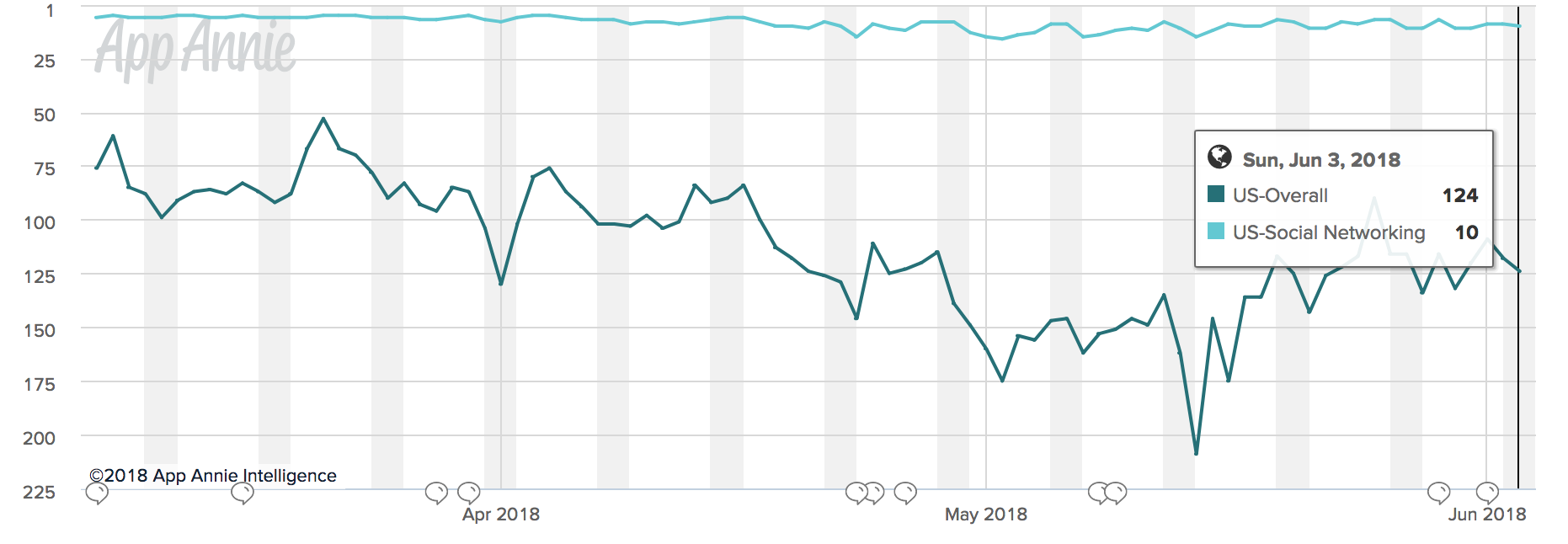
Houseparty, for example, sits at around #10 on the App Store for the social category and still a top-200 app, according to App Annie. It has a 4.4-star rating in the App Store and was last updated at the beginning of June, according to the App Store. So it’s still chugging along, though it does seem like Apple may nullify an app like Houseparty if it hasn’t locked in a huge and engaged fan base.

The next version of iOS tends to come out around the time of the next Apple event, which usually happens around September. Apple announced a stream of updates to iOS in its next version, iOS 12, including FaceTime group chats.


With iOS 12, Apple focuses on performance

Apple’s Craig Federighi announced that Apple was doubling down on performance with the upcoming release of iOS 12 at the WWDC event in San Jose, Calif. today.

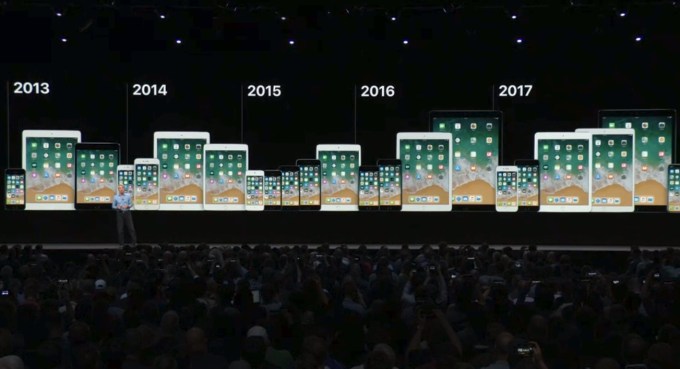
What’s more, he said, the company would be making these changes to the full range of iOS devices going back to 2013. “And so for iOS 12, we are doubling down on performance from top to bottom making improvements to make your device faster and more responsive. And because we want these changes to be available the full range of our customers, iOS 12 will be available on all the same devices as iOS 11,” Federighi told the WWDC audience.

Perhaps because customers were unhappy to learn about the battery issues with older iOS devices Federighi stressed that Apple has focussed these performance increases on older devices, giving people with older iPhones, the maximum lift. Using the iPhone 6 as an example, he gave some figures about performance increase, stressing that it was still early days. (As an iPhone 6 user, I was listening carefully.)

“Now on that device, iOS delivers a number of improvements. Across common operations you’ll see that apps launch up to 40% faster, the keyboard can come up to 50% faster and you can slide to take a photo at up to 70% faster,” he said.

But he said, the biggest focus, and one all iPhone users can appreciate, is that they are working to optimize performance when it’s under load. As Federighi said that’s when you need performance the most and where iOS 12 really shines.

“We put iOS 12 through our stress tests and we saw in those conditions share sheet coming up twice as fast, and apps launching twice as fast. These are big, big improvements,” he stressed.

Lastly, Apple also optimized iOS 12 at the chip level working with the chip team to optimize performance, while taking battery life into account. If you keep the power pedal to the metal for too long, you suck battery, but Apple is trying to find that perfect balance of power and battery life in iOS 12.

“CPUs traditionally respond to an increased demand for performance by slowly ramping up their clock speed. Well, now in iOS 12, we’re much smarter. When we detect that you need a performance lift when you’re scrolling and launching an app, we ramped up processor performance instantly to its highest state delivering high performance and a ramp it down just as fast to preserve battery life,” he said.

All of this will be available when iOS 12 is released later this year.

Apple introduces iOS 12

Apple announced the next version of iOS at its WWDC developer conference. While iOS 12 won’t be available before the fall, it’s always interesting to get a sneak peek at the next version of iOS.

Apple's senior vice president of Software Engineering Craig Federighi first talked about some numbers. 81 percent of iOS users are currently running iOS 11. 6 percent of Android users are currently on the last version.

“For iOS 12, we’re doubling down on performance,” Federighi said. iOS 12 is going to be available on all devices that currently support iOS 11.

It’s interesting the Federighi talked about iOS 12 on the iPhone 6 Plus. Apps launch 40 percent faster, the keyboard comes up 50 percent faster and opening the camera is 70 percent faster.

You get the idea, the big new feature of iOS 12 is performance and optimization.

But it doesn’t mean that Apple didn’t think about new features. Apple has created a new file format for augmented reality called USDZ. Adobe CTO Abhay Parasnis talked for a couple of minutes to announce that Adobe apps are going to support USDZ.

Apple is launching a new app to educate people about augmented reality. This app is called Measure and works pretty much like popular third-party app MeasureKit. While Apple says USDZ is a file format for augmented reality, Federighi also showed a USDZ 3D file in the middle of an Apple News article.

And the company is also updating ARKit with multiplayer augmented reality. You can get the same augmented reality experience with multiple devices.

This is a developing post, please refresh for updates.

Live from Apple’s WWDC 2018 keynote

It’s that time again. This morning kicks off Apple’s annual World Wide Developers Conference. It’s a week of programming focused on developers, but this morning’s big event has a little something for everyone. Here’s a quick break down of what we can likely expect when Tim Cook takes the stage this morning.

The keynote will most likely be focused on announcements surrounding iOS 12 and macOS 10.14 — in fact, we got a bit of a preview of the latter over the weekend. WatchOS and HomeKit will probably get some love, as well, along with ARKit, which took center stage at the event, this time last year.

As for hardware — expect Apple to throw us a couple of bones on that front, as well — though the really big announcements around iPhone, iPad and the like, are probably being saved for another day. Beyond that, the sky — or the San Jose Convention Center ceiling, at least — is the limit.

We’ll see you right here at 10AM PT/1PM ET/5PM GMT

How to watch the live stream for today’s Apple WWDC keynote

Apple is holding a keynote today at the San Jose Convention Center, and the company is expected to unveil new updates for iOS, macOS, tvOS, watchOS and maybe also some new hardware. At 10 AM PT (1 PM in New York, 6 PM in London, 7 PM in Paris), you’ll be able to watch the event as the company is streaming it live.

Apple is likely to talk about some new features for all its software platforms — WWDC is a developer conference after all. Rumor has it that Apple could also unveil some MacBook Pro update with new Intel processors.

If you have the most recent Apple TV, you can download the Apple Events app in the App Store. It lets you stream today’s event and rewatch old events. Users with old Apple TVs can simply turn on their devices. Apple is pushing out the “Apple Events” channel so that you can watch the event.

And if you don’t have an Apple TV, the company also lets you live-stream the event from the Apple Events section on its website. This video feed works in Safari and Microsoft Edge. And for the first time, Apple says that the video should also work in Google Chrome and Mozilla Firefox.

So to recap, here’s how you can watch today’s Apple event:

  • Safari on the Mac or iOS.
  • Microsoft Edge on Windows 10.
  • Maybe Google Chrome or Mozilla Firefox.
  • An Apple TV gen 4 with the Apple Events app in the App Store.
  • An Apple TV gen 2 or 3, with the Apple Events channel that arrives automatically right before the event.

Of course, you also can read TechCrunch’s live blog if you’re stuck at work and really need our entertaining commentary track to help you get through your day. We have a big team in the room this year.

Friday, 1 June 2018

Apple Pay tests ‘order ahead’ for drinks at music festivals

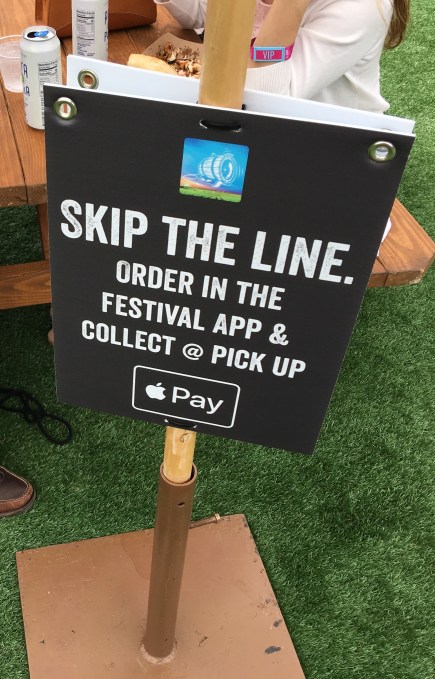
Apple is fixing one of the worst parts of the concert experience: waiting in line for a beer while you miss your favorite song. Last week’s BottleRock music festival near San Francisco was the first to try a new ‘order ahead with Apple Pay’ feature that Apple hopes to bring to more events. You just open the festival’s app, select the closest concession stand, choose your drinks, Apple Pay with your face or fingerprint, and pick up the beverages at a dedicated window with no queue.

Check out our demo video below.

BottleRock’s upscale wine & oldies music fest, 100 miles from the tech giant’s headquarters, has become a testbed for Apple Pay. Last year, every concession stand got equipped with the Square’s Apple Pay-ready point of sale system and special fast lanes for customers who used it instead of cash or credit card. 30% of all transactions at BottleRock were made with Apple Pay, according to an Apple spokesperson, proving people wanted a faster way to get back to the show.

With order ahead, your drinks are ready for pick up so you don’t even have to break your dance stride. Having gone to 14 Coachellas, I’d learned to forego booze rather than risk losing my friends or a chance to hear that hit single while stewing in the beer garden lines. But Apple Pay powered the best concert commerce experience I’ve had yet. I’m sure I’m not the only one who knocked back a few more drinks last weekend because it was so convenient.

That’s why I foresee music festivals jumping at the chance to integrate order ahead with Apple Pay into their apps. They and their vendors will see more sales, while attendees see more music. Meanwhile, it’s a smart way for Apple to reach a juicy demographic. Apple Pay is especially helpful when you’re in a rush, but festival goers will return home more likely to use it day-to-day.

Often times, music festival tech like friend finding apps and location-based alerts can interrupt the moment. Apple Pay succeeds here by fading away, keeping you in harmony with the present.

Apple to launch its own ‘digital health’ features in iOS 12, says report

At Google I/O in May, the company introduced a series of time management tools for Android users that help better manage screen time, track app usage, and limit the phone’s ability to distract, including a “shush” mode which turns on Do Not Disturb by flipping the phone over, and a “wind down,” color reduction mode for bedtime. Now, it seems Apple will follow suit with its own digital wellbeing features in an upcoming release of the iOS mobile operating system, a new report claims.

According to Bloomberg, Apple will introduce a new set of digital wellbeing features for iOS users at its Worldwide Developer Conference (WWDC) in San Jose on Monday.

The tools will be later released as a part of iOS 12 operating system for iPhone and iPad devices, which typically arrives in the fall.

The report was light on details in terms of which specific metrics Apple will track, but says those details will arrive in a new menu inside the Settings app in iOS 12.

The initiative, called “Digital Health,” will monitor how much time users spend on devices, but it’s unclear if it will also include tools that help users silence their phones using new gestures or settings, or otherwise disengage from their devices.

The digital wellbeing movement is part of a fairly recent course correction for Silicon Valley tech companies, which are now being held accountable for the addictive nature of the devices, apps and services they’ve created.


From the beginning, tech company engineers and designers were encouraged to make their products ever more engaging by taking advantage of specific design patterns that prompt regular, addictive usage of their products, and those that increase users’ time spent in apps.

But more recently, some tech execs have come to espouse regrets for what they’ve built. Former Facebook president Sean Parker stated Facebook’s design exploited weakness in the human psyche to addict users, and said he worried about what it was doing to kids’ brains. Meanwhile, former Google exec Tristan Harris launched a coalition of technologists and activists called the Center for Humane Technology, which aims to encourage “humane design” – that is, design that reduces distractions and stress, and keeps people from being hooked on their devices.

Now the industry giants are putting some of these principles into practice.

Facebook earlier this year changed how its News Feed operates to reduce users’ time spent on the site in favor of well-being. Instagram last month introduced its first time well spent feature, by informing users “you’re all caught up” when they’ve viewed all the new posts. Google launched parental control tools in its Family Link service that allow parents to limit kids’ screen time, and introduced the above-mentioned digital wellness features for Android in May.

If Apple were to avoid the topic, it would be the odd one out at this point.

The new digital wellbeing tools will likely be detailed during Monday’s WWDC keynote address, and may include some additional protections for children through an update to iOS’s parental controls. We do know that more robust parental controls are at least coming, as Apple promised this explicitly following criticism from major shareholders about children’s iPhone addiction.