Everything Apple

Tuesday, 12 June 2018

Uber bets on developing world growth with low-data Uber Lite

“The next hundreds of millions of riders for us are going to come from outside of the United States”, Uber’s head of rider experience Peter Deng tells me. The transportation giant already sees 75 million riders per month and 15 million rides per day. But to grow in the developing world, it had to rethink its app to work on the oldest phones and slowest networks. So Deng’s team traveled the globe asking people what they needed from Uber, but also what they didn’t.

The result is Uber Lite.
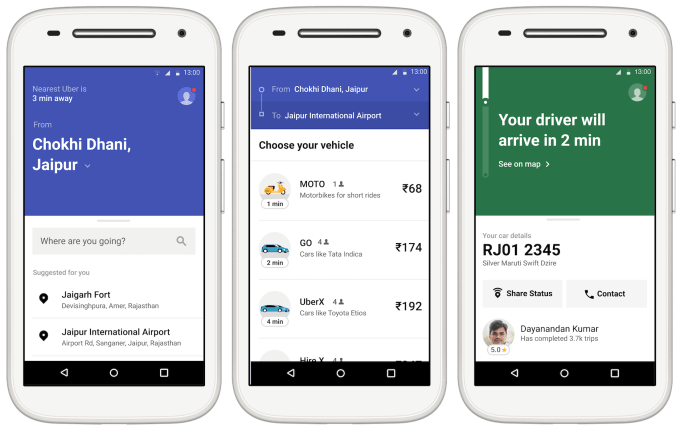
It’s launching today in India before rolling out to more countries, though there’s still a waitlist form instead of a download link. The Android app takes up just 5 megabytes. “You delete three selfies, you have room for Uber” Deng laughs. 300-millisecond response time means its quick to hail a ride, even for the 4 percent of users in India on sluggish 2G networks. And by streamlining the design and only showing maps by request, it won’t burn much data for users on a budget.

Uber needs to score growth in developing markets after retreating while cutting deals with local winner like Didi in China, Grab in Southeast Asia, and a forthcoming arrangement with Yandex in Russia. India’s Ola rideshare service already has a ‘Lite” app that’s just 1 megabyte and a 45% share of the taxi market, compared to Uber’s 35%. Uber has reported has talked with Ola about a possible merger in India, sources have told TechCrunch and others. With the country making up 10% of Uber’s rides, it’s a market it can’t forfeit.

To reach its full potential, Uber has to start out-competing homegrown competitors. Success with Uber Lite could give it leverage with Ola and path to gaining more of it around the world.

“We know we’re not just a U.S. company, we’re a global company. Not only have we built this for the world, it was built in India” Deng tells me. Deng came to Uber in March 2017 after 10 years at Facebook’s various companies. It was early to the “Lite” idea, with its shrunken app reaching over 200 million users. 

But Deng says Uber Lite didn’t come from stripping down the main app, but building it up from scratch. “The team has traveled to markets around the world to do in home interviews to understand the needs of the customers.”

Compared to the 181 megabyte standard version, Uber Lite is a lot easier for low-storage phones to handle. Uber Lite launches not to a map or a text entry box, but instead a suggested nearby business or landmark based on your GPS. “You have to do less typing and can do more tapping” Deng explains. It also tries to guess your destination based on pre-cached popular city spots. You can input addresses, but Uber Lite won’t load a data-heavy map unless you purposefully grab for it. ‘Tap for map’.

Same goes for your driver’s ETA. After you’ve selected your vehicle type and hailed, you’ll just get a countdown to their arrival unless you tap to see them on their way. Payment for now is cash only. But soon Uber plans to add India’s popular Paytm payment platform and credit card options. It’s also still lacking notifications, which seem worth the data. More languages will come too.

Uber wouldn’t explain how, but it also revealed that it plans to offer offline hailing, possibly through some peer-to-peer Bluetooth mesh network or other technology. One other interesting test its running in India lets users punch in a code found at a bus stop to instantly hail a ride there. Another lets older or less phone savvy users phone in to an accessibility team that can hail a ride for them. It’s already offered web bookings. “The whole charter is to allow everyone around the world to experience Uber” Deng says.

What Uber wouldn’t skip in v1 was the in-app support and a way to share your ETA with loved ones so they can watch out for you. “We knew how important safety was in these markets. I’m really proud we took additional steps to empathize” Deng says.

The company is clearly trying to put the darker moments of its past behind it. While cynics might take the compassion talk as just lip service like the company’s big apology ad campaign, it’s also the reason some tech talent has stayed at or joined Uber. If the company is going to be unavoidable, making it secure and accessible is a pretty good reason to wake up in the morning.

Monday, 11 June 2018

Instagram plans June 20th launch event for long-form video hub

Last week TechCrunch reported Instagram will launch a long-form video hub to compete with Snapchat Discover and YouTube, with a tentative launch date of June 20th. Now Instagram is asking reporters to RSVP for a June 20th “special event”, confirming our scoop’s date. The invitation simply reads “Instagram has some news to share, and we want you to be the first to hear about it.”

Here are the details of long-form video hub that we’ve heard from our sources:

  • Format: Instagram will let creators upload 4K, full-screen, vertically oriented videos ranging much longer than the current 60 second limit on videos.
  • Destination: The videos will be available from a centralized hub featuring curating sections of popular videos and an option to continue watching clips you’ve already started, though it’s unclear where in its app or a separate Instagram will host this destination
  • Launch Partners: Instagram has been meeting with social media stars and content houses to establish launch partners for the June 20th reveal
  • Mid-Level Quality: The content is meant to approximate the clips you see on YouTube from star creators, shot with forethought and nice cameras, but most of it won’t be at the Netflix Originals or HBO-quality.
  • Link-Outs: Instagram will let creators add a link that can visited by swiping up on the video so they can drive traffic to their other social presences, ecommerce stores, or websites.
  • Monetization: Instagram plans to let creators earn money off their long videos, though it hasn’t finalized how yet. That couldtake the form of pre-roll ads or mid-break commercials, with creators potentially earning a revenue share.

It’s also quite possible that Instagram will announce that it’s hit 1 billion users, which would be a great way to draw content creators. Instagram hit 600 million in December 2016, 700 million in April 2017, and 800 million in September 2017. If it’s adding 100 million users every four months or so, that means it should have reached 1 billion by the June 20th event.

Xiaomi posts $1.1B quarterly loss ahead of much-anticipated IPO

A month after it filed for a much-anticipated Hong Kong IPO, Xiaomi has revealed a little more financial information after a monster 621-page document disclosed a $1.1 billion (seven billion RMB) loss for the first quarter of the year.

The IPO, which could value Xiaomi at up to $100 billion, could to be the largest IPO raise since Alibaba went public in the U.S. in 2014, and it will be boosted with a dose of positive financial growth despite a loss incurred by one-off payments.

The document, which was filed was an application to issue a CDRs as part of a dual-listing, showed that Xiaomi’s revenue for the quarter jumped to 34 billion RMB, or $5.3 billion. That’s compared to 114.6 billion RMB ($17.9 billion) in total sales for all of last year, according to digging from TechCrunch partner site Technode.

While Xiaomi posted a loss for the quarter, the firm actually posted a 1.038 billion RMB ($162 million) profit for the period when one-time items are excluded. Xiaomi previously registered a 43.9 billion RMB ($6.9 billion) loss in 2017 on account of issuing preferred shares to investors (54 billion RMB) but it did post a slim profit in 2016.

The company is ranked fourth based on global smartphone shipments, according to analyst firm IDC, and it is one of the few OEMs to buck slowing sales in China.

China is, as you’d expect, the primary revenue market but Xiaomi is increasingly less dependent on its homeland. For 2017 sales, China represented 72 percent, but it had been 94 percent and 87 percent, respectively, in 2015 and 2016. India is Xiaomi’s most successful overseas venture, having built the business to the number one smartphone firm based on market share, and Xiaomi is pledging to double down on other global areas.

Interestingly there’s no mention of expanding phone sales to the U.S., but Xiaomi has pledged to put 30 percent of its IPO towards growing its presence in Southeast Asia, Europe, Russia “other regions.” Currently, it said it sells products in 74 countries, that does include the U.S. where Xiaomi sells accessories and non-phone items.

Despite its design progress, relative age as an eight-year-old company and the fact it is shooting for a $100 billion, Xiaomi left some spectators disappointed when it wheeled out a very iPhone X-looking new device earlier this month. While the company claims the Mi 8 is packed with new technology, it’s hard to look past the fact that a number of its visual designs are identical to Apple’s flagship smartphone. Xiaomi could have made a stronger statement of intent with the launch, but it will hope its financials can do the talking as it moves into the last moments of preparation before its public listing.
Thursday, 7 June 2018

SeatGeek brings ticket buying into Snapchat

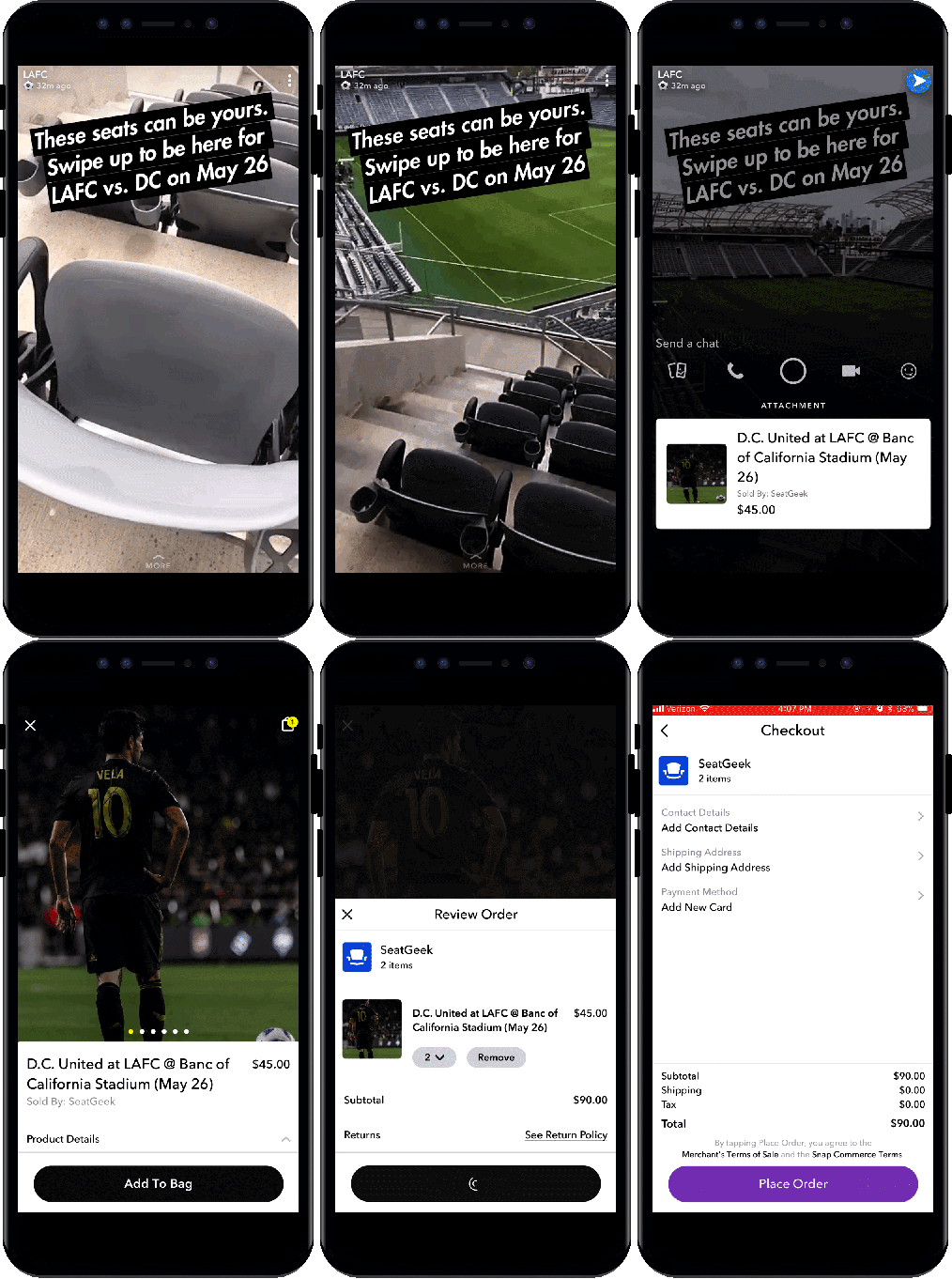
You can now buy game and concert tickets from teams and musicians within Snapchat, thanks to an integration with SeatGeek.

While Snapchat has started testing e-commerce features in the past few months, SeatGeek says this is the first ticket-buying experience built into the Snapchat app.

The Los Angeles Football Club was the first team to sell tickets through this integration, by posting a Snapchat Story (and a Snapcode on the team website) that allowed users to swipe up to buy tickets to the May 26 game. The full purchase experience takes place without leaving the app.

“We’re always looking to reach our fans in innovative ways, and selling tickets directly to our followers on Snapchat gives us an incredible opportunity to connect with our most dedicated supporters,” said Los Angeles Football Club President and co-owner Tom Penn in the announcement.

SeatGeek Snapchat

SeatGeek co-founder Russ D’Souza said that as “the pipe gets solidified,” you’ll start seeing more Snapchat/SeatGeek ticket sales. He added that this the kind of integration he was hoping for when the company launched the SeatGeek Open platform a couple years ago, allowing teams, musicians and other rightsholders to sell tickets directly through SeatGeek. (The platform also supports ticket sales through Facebook.)

“For too long, the legacy ticketing approach has been to make it difficult for teams to sell tickets in lots of places,” D’Souza said. “Teams should want to sell their tickets in as many places as possible.”

And it sounds there are additional deals in the works: “What we’re excited about over the next few months is beating the drumbeat of openness with new partnerships … We want to drive the whole industry forward and create more tangible results that cause the industry to open up.”

Here’s the sequel to the surprisingly nice BlackBerry KeyOne

TCL just dropped the sequel to the KeyOne, the company’s surprisingly good keyboard-sporting BlackBerry handset. We reviewed it roughly this time last year, and it was almost enough to restore our faith in the possibilities of BlackBerry as a brand. Almost. Of course, that had much more to do with TCL’s ability to create solid hardware than any residual BB legacy.

The Key2 builds on the promise of its predecessor, bringing back the physical keyboard and familiar BlackBerry-styled design, constructed around a 4.5-inch touchscreen and aluminum frame. The phone, naturally, runs Android (8.1 to start), loaded up with your standard suite of BlackBerry software, including DTEK. The security app has been updated with an new Proactive Health feature, which offers a full system scan.

As TCL proudly notes, this is the first BlackBerry/BlackBerry-branded device to feature dual rear-facing cameras, so that’s something. The pair of 12-megapixel cameras help deliver the device into 2018 with features like Portait Mode, Optical Super Zoom and Google Lens.

There’s a chunky 3,500mAH battery and a middling Snapdragon 660, coupled with a generous 6GB of RAM and either 64- or 128GB of storage. Not too shabby, but all of that comes with a $649 price tag, which marks a $100 premium over the KeyOne, which should make this a bit of a tougher pill to swallow for what to many no doubt still feels like a bit of a novelty in the smartphone category.

The Key2 starts shipping this month, and TCL tells me that it plans to keep selling the KeyOne as well, for the time being.

Revolut announces a Robinhood-like trading product

Fintech startup Revolut likes to announce new things all the time. Even though nothing is going live today, it’s interesting to see where the startup is heading. The company is working on a trading platform for traditional shares without any commission.

You’ll find stock from public companies from the U.K. and the U.S., as well as various ETFs and options. In other words, Revolut is going to become the Robinhood of Europe.

While American customers have been using Robinhood for years, the rest of the world has been lagging behind when it comes to stock trading.

You still have to open an account on a painfully slow website and pay a few euros for every transaction. Some companies even ask you to send a letter to create an account. And if you want to buy stock through your existing bank account, it usually costs even more.

Revolut promises that you won’t pay any commission when you buy or sell shares. The company plans to make money on margin trading, securities lending and interest on cash. Unfortunately, Revolut didn’t say when the feature would launch.

Premium subscribers will be able to test the feature first. Eventually, you’ll also get additional perks if you’re a premium subscriber. Trading will be available to all Revolut users in Europe and future markets. The company plans to launch in the U.S., Canada, Singapore, Hong Kong, Australia and New Zealand in the coming months.

Revolut’s premium subscription is becoming a sort of Amazon Prime for financial products. You pay £6.99/€7.99 per month and you get unlimited foreign exchange transactions, travel insurance, access to new features and more.

It’s clear that Revolut plans on making predictable revenue on this premium subscription. And maybe the trading platform will make more people subscribe to Revolut Premium.

Additionally, Revolut now officially has 2 million users. It’s funny to see that Revolut is announcing this new milestone just days after N26 announced a million users. Interestingly, Revolut has 900,000 users in the U.K., where N26 has yet to launch.

Wednesday, 6 June 2018

Android P Beta 2 brings updated system images and 157 new emojis

A month after releasing the first beta version of Android P at I/O (and right in the middle of Apple’s own developers conference), Google has just released Beta 2 of its upcoming mobile operating system. The update is available to users enrolled in Google’s developer program, who have access to a Pixel device. Those who’ve already download Beta 1 will get the new version automatically.

The latest build features new system images and tools designed to help developers create apps for the upcoming version of the mobile operating system. Adaptive Battery is on-board here, leveraging DeepMind to decide which apps should get the most system resources. App Actions helps developers make their apps more prominent in places like Search, the Google Assistant and the Google Launcher, while Slices provides a way to offer elements of an app without having to open it up. 

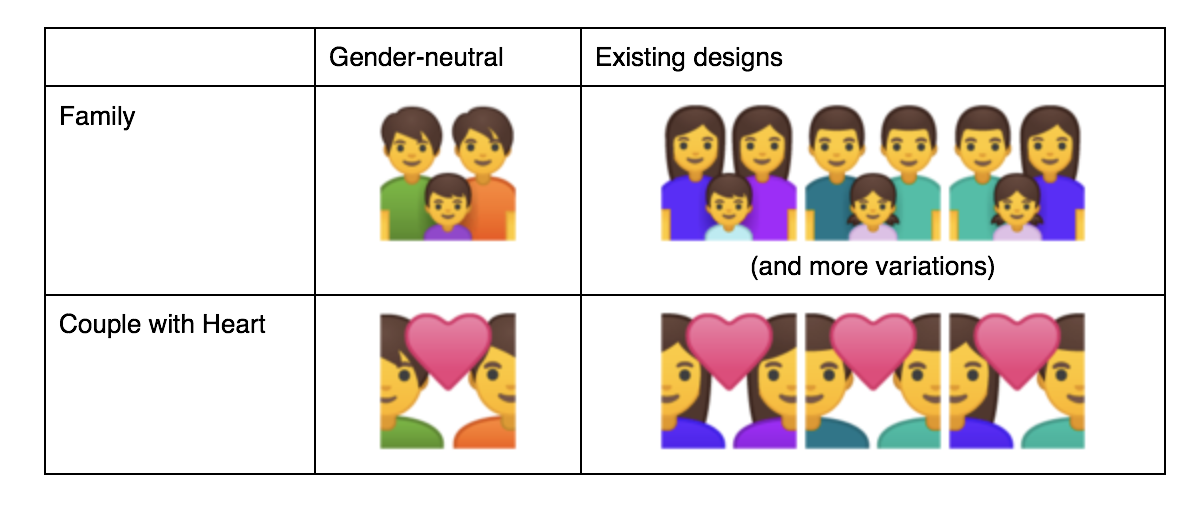
Also of note is the addition of 157 new emojis. The list includes two gender neutral emojis, offering awn additional options for the Family and Couple With Heart emojis, joinging last year’s addition of a gender-neutral Adult emoji.

There’s a Red Hair and Superhero emoji, both of which are available in two genders and five skin tones, a bagel with cream cheese, a llama and a lobster. Sounds like a fun crew.

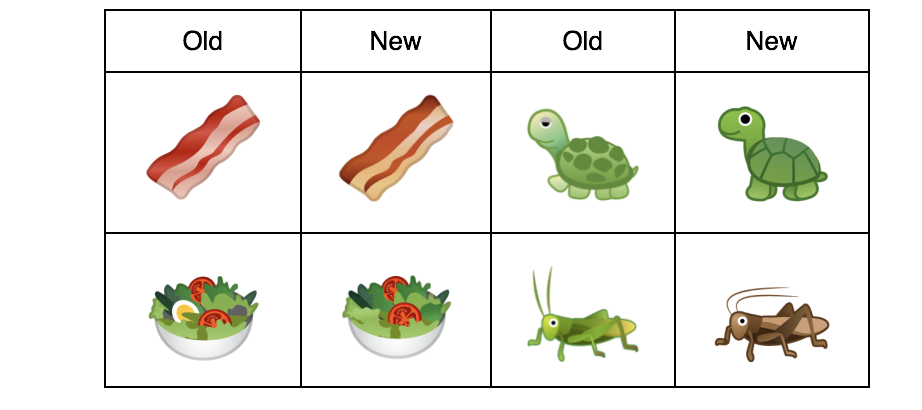
A handful of existing emojis have also gotten a facelift here, including Bacon, Turtle, Cricket and Salad, which drops the egg to go full-on vegan. Google notes that the new emojis may be further updated prior to Android P’s final release.

More information on the updates for devs can be found here. 

Kayla Itsines’ Sweat app will rake in $77 million this year

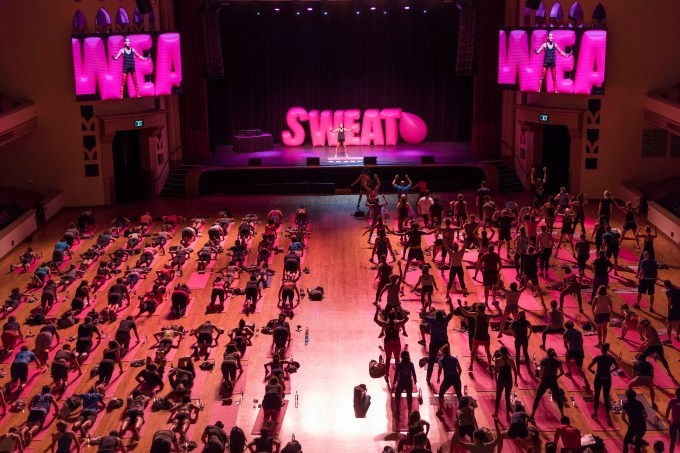
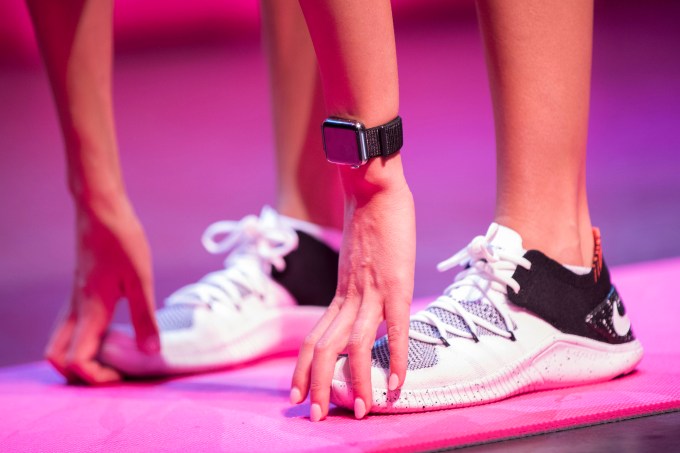
In earlier years, fitness gurus would market their programs for getting in shape on VHS tapes and, later, DVDs. These days, it’s an app business. At Apple’s Worldwide Developer Conference this week in San Jose, the company brought in one of the fitness app industry’s superstars, Kayla Itsines, co-creator of the BBG (Bikini Body Guides) and the Sweat app – which will pull in $77 million USD this year – to lead a morning workout for around 200 conference attendees.

For Apple, Kayla’s brand represents not only a good App Store success story, but also spreads the message of how its own products, like iPhone and Apple Watch, enable access to better health through their platforms.

From e-books to apps

Kayla’s fitness company was started several years ago by two personal trainers – herself and business partner Tobi Pearce. Both were using social media, including Instagram, to drive leads for their own PT sessions and bootcamps.

But Itsines’ online profile really took off and soon, people from all over the world wanted to know how they could train like her and get the same results.

WWDC Workout with Kayla Itsines

So the trainers packaged up her program materials and sold it as an e-book online starting in early 2014. Over the next year or so, the business grew, as they distributed more e-books and a broader content series.

But Kayla and Tobi wanted to reach even more people, so they turned to the App Store.

“That’s where our consumers are,” said Tobi, speaking of the company’s decision to launch a mobile app, in a conversation with TechCrunch backstage at the WWDC fitness event.

“We have mostly millennial consumers – 25 to 35 is our main market,” he continues. “Part of being a personal trainer is that you get to be there – personally – and train people in real-time. Now, obviously, you can’t do that for every person in the world, and an e-book can’t do that. But Apple allowed us to do that,” he says. “The Apple ecosystem is kind of a no-brainer.”

WWDC Workout with Kayla Itsines

The team launched the Sweat app in November 2015, but it got a big refresh – almost a full relaunch – early last year, with three to four times the amount of content.

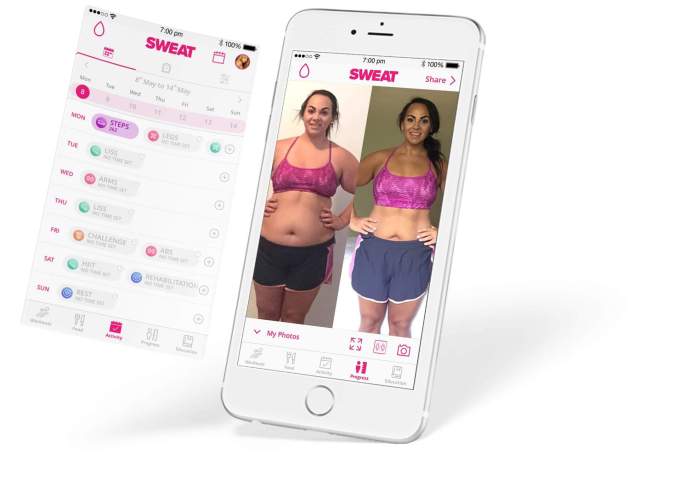
Today, the Sweat app is a one-stop shop for fitness programs for women, featuring not only Kayla’s own content, but other trainers’ programs as well, across areas like yoga, pregnancy and gym workouts, for example.

Subscribers pay $19.99 per month to use the Sweat app, which is cheaper than the gym, or they can opt for an annual membership to save 50 percent.

However, not all of Sweat’s users are turning to the app instead of the gym – it can also be a companion for those who want the assistance of a personal trainer in a gym environment, but not want to pay the hundreds of dollars they tend to charge.

And thanks to team Kayla’s social media savvy and the team’s marketing prowess, they’ve built a community that’s happy to pay, it seems.

These days “well over a million” people use the app on a monthly basis, out of 30 million total app downloads, Tobi tells TechCrunch. And though the company’s now 70-person team is largely based in Australia, the U.S. is Sweat’s largest market.

“Since re-launching [the Sweat app], we had a really big growth year – we grew about 86 percent last year, which is pretty huge for us. And this year, we’re on track to hit about $100 million in revenue this year – that’s AUD,” Tobi clarifies.

In U.S. dollars, that’s around $76.75 million – not bad for a fitness app that never took in outside capital.

“When we first started doing the e-books, I had a few bootcamp franchises of my own, and Kayla had a small studio that she ran…I put up most of my own money, initially,” Tobi explains. “It was sort of big turning point in both of our careers because we could – you know: the Australian dream, buy your own home – or we could invest a hundred thousand dollars and hope something comes out of it.”

WWDC Workout with Kayla Itsines

What’s next: Apple TV, AR and…funding?

Part of the Sweat app’s appeal – beyond its promised results, of course – is its use of new technologies to keep people engaged.

The current app leverages Apple Watch’s visual interface to give video cues, and it added audio cues to the iOS app so the trainers can talk to you as you work out – much like an in-person trainer would. (That feature is coming to the Watch soon, so more advanced users who don’t need the videos can just listen through their headphones or AirPods to hear what to do next.)

Sweat also includes its own curated music playlist streamed through Apple Music, and, in the future, the Sweat program is expanding to Apple TV.

Tobi says they have plans to do something with augmented reality as well, but couldn’t offer more details.

“I’m not too sure yet [what we’re doing with AR], I guess we’re kind of curious,” he admits. “It’s almost part of our responsibility and obligation. We’re a market leader for women’s fitness, and if we want to continue to be that, we want to have the best technologies,” he says.

While Sweat isn’t in need of outside investment, the team isn’t ruling out the idea entirely.

“I don’t necessarily think it would be a bad idea. I think, obviously, for all businesses at any stage –  whether it be really early on with venture capital, or whether it be a different type of funding later in the lifecycle of the business – I think it always serves a purpose, honestly,” says Tobi.

“Now we’re in the cycle of trying to optimize the experience to get the best results for the user – whether it be content or features or whatever. Having a funding partner – not so much necessarily just for the capital, but also for the resources and the network – would be really handy,” he says. 

Facebook introduces new bidding support for in-app ads

Facebook is expanding its support for header bidding, a technology that allows publishers to auction off ad impressions through real-time bidding between ad networks.

The company announced its support for header bidding on the mobile web last year. Today, it’s adding something similar for in-app advertising.

That means app publishers who use header bidding can include ads from Facebook’s Audience Network in their auctions. To enable this, Facebook is partnering with Fyber, MAX and Twitter’s MoPub.

Here’s how Facebook’s Vijay Balan laid out the benefits of the new approach:

Currently, ad networks are called one-by-one until an app ad is filled, determined by historical average CPMs rather than which buyer is willing to pay the most. This method often overlooks a network willing to pay more for an impression because it is lower in the chain.

App bidding enables app publishers and developers to establish an impartial and open auction over their ad inventory. All advertising networks are called simultaneously and the highest bidder for the placement wins, thereby providing publishers with opportunities to earn more. Publishers can maximize their access to high value advertisers, fueling the creation of sustainable ad businesses that help ensure people continue to enjoy access to high quality free content.

Balan said Facebook has already been testing this with publishers who have their own ad-serving technology, including Rovio, Talefun and GameInsight. Those early tests have seen revenue gains of up to 20 percent.

Motorola’s Z3 Play modular handset arrives this summer for $499

At an event in Brazil this morning, Lenovo announced the latest addition to its line of modular handsets. The Moto Z3 doesn’t represent a big leap for the line, but it does introduce a slight change in approach for a company hoping to make a bigger splash on the modular side of the question.

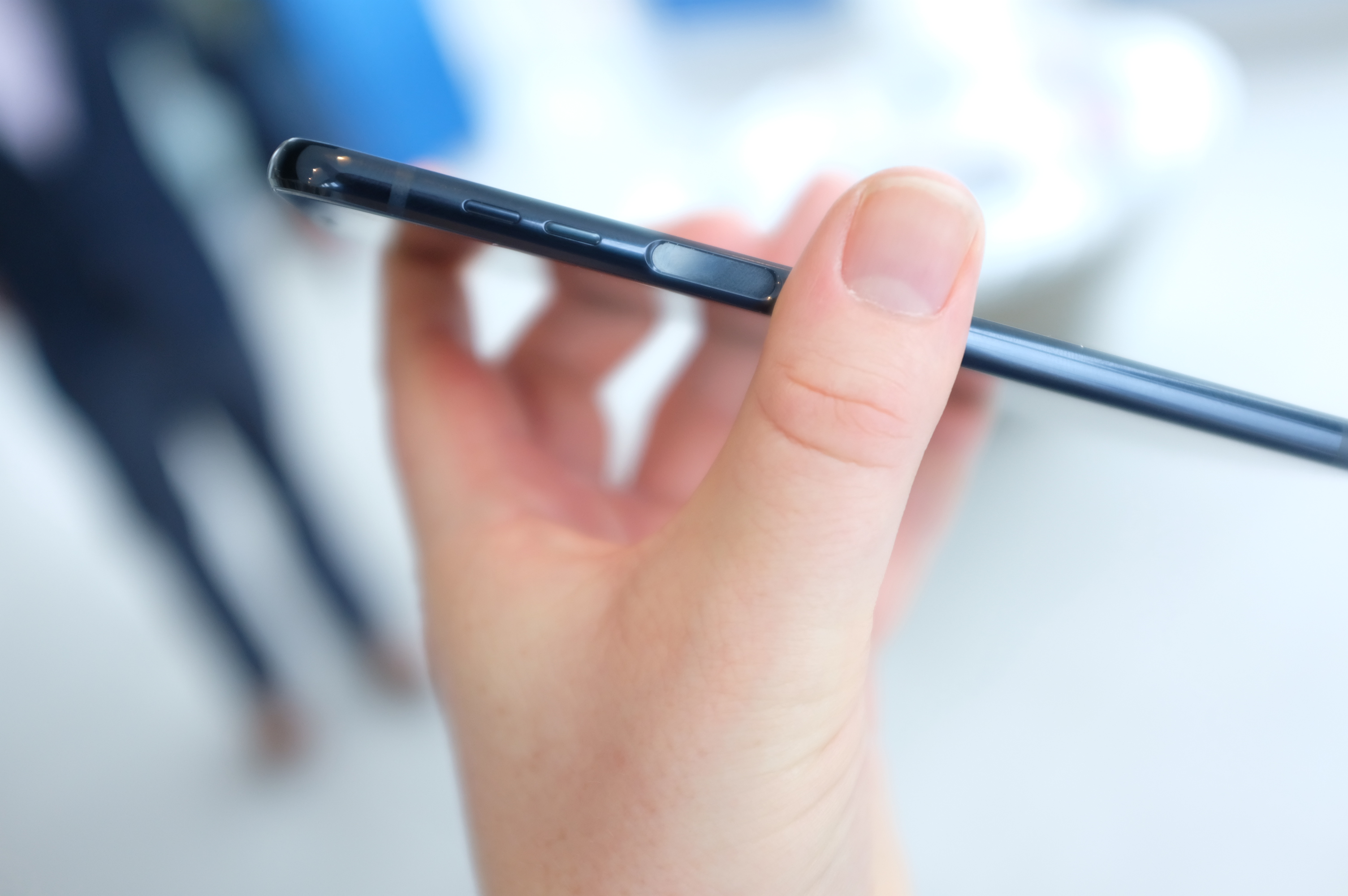
Like its predecessor, the Z3 Play will be priced at an extremely reasonable $499. That includes some upgrades, such as a slight redesign with a glass back (Gorilla Glass 3 on both sides) and a screen that’s been extended to six inches (a 2160 x 1080 resolution at 18:9), courtesy of thinner bezels and fingerprint reader that’s been moved around to the side of the devices.

That’s a 79 percent screen-to-body ratio, by Motorola’s count, but no embrace yet of the nearly ubiquitous top notch. The company, it seems, is saving that for the upcoming Motorola Power One, its upcoming iPhone X-like flagship. The Z3 Play, for all of the flashiness of modularity, is still a mid-tier handset, as evidenced by (among other things), the octa-core Snapdragon 636 inside.

One of the key differentiators here, however, is how the company is selling the device. Bundles make a lot of sense with a device for which accessories are a key selling point. A number of third parties have offered some version of this, discounting mods with the purchase of the phone. Now, however, the bundles are being offered from the get-go, included as part of that $499 price point.

The Z3 will ship with either Motorola’s first-party speaker or battery pack. Availability will depend on the country. Here in the States, for example, it seems we’ll only be getting access to the battery version, which augments the handset’s solid 3000 mAh “all day” battery. It is, understandably, the best-selling Moto Mod — the speaker, meanwhile, is in second place. The availability of said bundles will be dependent on the popularity of those devices in a given location.

Motorola’s given out these numbers before, but they bear repeating: one-third of those who purchase a Moto Z device end up picking up a Mod. Roughly 60 percent of that number, meanwhile, buy two or more. Those numbers are surprisingly low, given that Mods seems like such a central selling point for the product.

After all, the company has made some sacrifices for such modularity. Chief among these are the fact that there’s really not a lot of wiggle room with regard to device footprint. As long as the company wants to continue making the devices backward-compatible with Mods, the phones are going to have remain roughly the same size.

Motorola squeezes a little more screen out of the device through the above-mentioned methods, and while it tells me that it’s confident there’s still space to work with on future devices, it does seem to have painted itself in a corner here. For all of Essential’s seeming struggles, the device’s connector allowed for a broader range of sizes and shapes.

The company’s no doubt hoping these bundles will kickstart interest in Mods. Until one comes along that really excites the fan base, however, it’s easy to see how making the two most popular Mods available essentially for free could ultimately eat into potential sales.

Meantime, the device will be arriving at Best Buy, Walmart, Target, Fry’s and B&H Photo this summer. It will also be available through Amazon’s Prime Exclusive program.

Order-ahead app Ritual picks up $70M to rethink the social office lunch break

While DoorDash, Postmates and other apps are looking to reimagine what the food delivery experience looks like, Ray Reddy says he wants to figure out what the next generation of a food court looks like. Sort of.

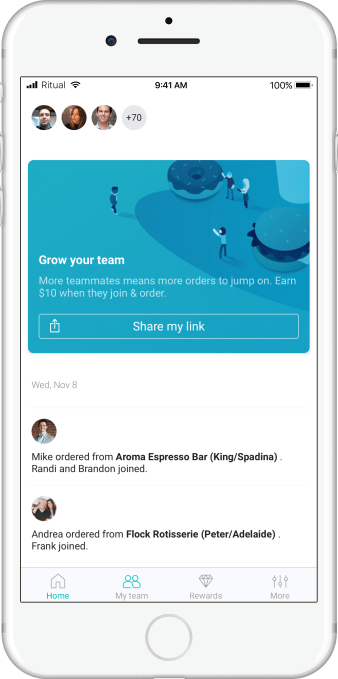
Reddy’s startup, Ritual, aims to remake the whole process of leaving your office and walking around five minutes to a nearby deli or cafe to pick up food for lunch. But Reddy and his founders Larry Stinson and Robert Kim wanted to focus first on getting that experience right for a single building that leaves to go pick up coffee or food — and has that daily ritual of getting lunch with the team, or something along those lines. The whole process boils down to an app for consumers to order food or drinks as well as have coworkers piggyback onto that order to create a more socialized experience around getting up and going around the corner for a snack. Ritual said it has raised a new $70 million round led by Georgian Partners, with existing investors Greylock Partners, Insight Ventures, and Mistral Venture Partners all participating.

“If we [couldn’t] build something that is compelling for the 300 people who work at this single building, it’s not gonna work period,” Redddy said. “That helped us define the problem narrowly. We thought, here are the 12 or 14 spots within a five minute walk of this building, let’s focus on simulating what would happen. Let’s not worry about financials or economics, let’s prove this works. Just like Uber’s a remote control for the real world, we viewed this in a similar way where ultimately the app is a remote control for a real world experience.”

Ritual’s main flow is probably something the typical user is accustomed to at this point when it comes to food. They pick a place they like, place an order for food (or coffee), and then go pick it up. But the whole background process involves not only getting restaurants on board with the specific things they want while still trying to calibrate a consistent experience that users at this point expect when it comes to ordering something online after being trained on that simplicity for years by Postmates, DoorDash, or even apps by companies like Starbucks.

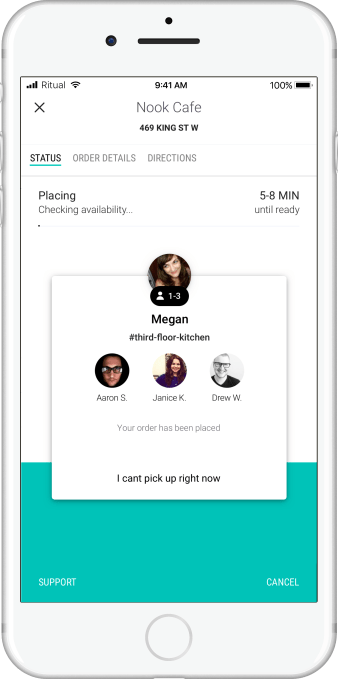
But over the past year or so, the company has increasingly tuned itself to employees jumping aboard the same order when considering what to pick up for a snack or a meal. The whole process aims at emulating that experience of figuring out where you want to eat in a Slack channel or arguing over a Seamless order, and in the end whoever has time to run out and grab something will be able to bring things back for teammates (or, of course, everyone can leave at the same time). That whole process is called “piggybacking,” a feature the company introduced around 18 months ago. The company has around 44,500 teams using the app, Reddy said.


All this is aimed to help restaurants adapt to the same changes in user behavior that retail has seen in the past decade, Reddy said. Amazon trained users to buy things online, forcing retailers to shift their strategies, just as Postmates and DoorDash have trained users to order food delivery through apps and immediately have access to a ton of options. With all that comes more and more data, which has helped those industries slowly tune their models over time and try to keep up with the increase in demand that has come with reducing friction around the whole experience.

“What restaurants are seeing are right now the same challenges retailers saw 10 years ago,” Reddy said. “What does it mean to become omni-channel, how do you go from one customer segment to dealing with walk-ins plus digital orders. Retailers faced a lot of those challenges 10 years ago, they faced challenges around pricing, fulfillment, and how do they build new capabilities. They are dealing with a new source of demand, and fundamentally the problem was a lot of stores weren’t designed for accepting multi-channel origins.”

While an order-ahead app might be one way to connect online users to a physical location, there’s still plenty of work to do as most restaurants, coffee shops or typical stores aren’t tuned for a digital-first experience, Reddy said. That extends to even not having enough counter space to hold coffee cups that customers have ordered ahead of time, much less including things like NFC readers or QR codes — the latter of which has proved wildly popular and effective throughout Asia thanks to services like Alipay and WeChat. And that’s largely a result of iOS and Android, the main platforms in North America, not really doing a lot with QR codes for a very long time. Reddy said that North America was making some progress, especially when it came to NFC, but for now the company still has to figure out unique ways to connect users to those restaurants.

That can take a lot of different forms. While Ritual has to figure out how to create a seamless experience that covers a lot of different restaurants or shops, Reddy said the startup still has to offer those same stores some kind of control over the experience. That means giving those customers some value proposition beyond just telling them to sign up for another order-ahead app. Ritual, for example, lets restaurants who onboard Ritual customers themselves keep the full transaction for a purchase, while it takes a small slice off other transactions. That, in addition to other marketing options, helps restaurants control their own destiny, he said.

Of course, at its heart, it’s an order-ahead app — even with that social experience on top of it. And if you’ve ever looked at where to eat nearby with coworkers, you’ve probably checked Yelp or a few other places, and possibly even settled the argument with a giant order on an online ordering platform like DoorDash or Seamless. All these have already tapped that user experience, and it’s not clear if Ritual would be able to clear enough room should any one of them go after a similar experience while already having that customer and user relationship, in addition to being the spot customers go already. In the end, Reddy says that it’ll come down to users having a few apps, and hopes that by offering restaurants flexibility and focusing on the hyper-local idea of just a single office building will help build up that moat.

“The way that things have played out in Asia [with platforms like WeChat] is exactly striking the right balance between a platform and giving stores control,” Reddy said. “When you think of the consumer view, people — for the same reason you don’t have 10 retail apps — don’t have 10 food apps. You’re not gonna download an app for every neighborhood spot. It’s not that these apps are bad or don’t work well, people are just not gonna download 10 apps. There’s gonna be a handful of platforms people are going to use to access their neighborhoods. We have to have a unified platform, but give restaurant partners enough control, not only over being able to speak with their customers, but control for the look and feel of their storefront. That’s the middle ground we’re looking to find, which we think is a win for customers and our storefronts.”

Europe to cap intra-EU call fees as part of overhaul to telecoms rules

European Union institutions have reached a political agreement over an update to the bloc’s telecoms rules that’s rattled the cages of incumbent telcos.

Agreement was secured late yesterday after months of negotiations between the EU parliament and Council, with the former pushing for and securing a price cap on international calls within the bloc — of no more than 19 cents per minute. Texts will also be capped at a maximum of 6 cents each, Reuters reports.

While roaming charges for EU travelers were abolished across the bloc last summer, the parliament was concerned that charges for calls and texts between EU Member States is often disproportionately high — hence pushing for the cap, which was not in the original EC proposal.

The Commission proposed a new European Electronic Communications Code back in 2016, to modernize telecoms rules that had stood since 2009 — to take account of technology and market shifts, and align the rules with its wider Digital Single Market strategy.

The proposal broadly focused on pushing for consistency in spectrum policy and management; reducing regulatory fragmentation; ensuring a level playing field for market players and protections for consumers; and incentivizing investment in high-speed broadband networks.

And on the incentivization front, the new rules agreed yesterday update the powers of national regulators to act against dominant players — such as by being able to impose access to their network.

For a case study on why such interventions might be necessary you could look at the fiber investment and network-access foot-dragging of a former incumbent telco such as BT in the UK, for example, which has long favored eking out copper. While its network infrastructure division OpenReach was last year ordered to be legally separated — around a decade after it was functionally separated by the regulator. Yet complaints over BT’s lack of investment in broadband infrastructure and access for rivals to its networks have, nonetheless, persisted.

On the consumer front, the new EU telecoms Code also includes measures intended to make it easier to change service provider and keep the same phone number; measures around tariff transparency to make it easier for people to compare contractual offers, and the ability to terminate a contract without incurring additional costs; as well as additional protections around bundled services.

For operators there are deregulation measures for co-investments — intended to promote “risk sharing in the deployment of very high capacity networks”. And the Code sets wireless spectrum licenses at at least 20 years — also intended to give carriers the “predictability” they need to speed up 5G and fiber deployments.

Though this is shorter than operators had hoped, and the European Telecommunications Network Operators’ Association (ETNO) — whose membership is made up of incumbent telcos such as BT — has been quick to voice its displeasure, describing the code as a “missed opportunity“, and complaining that it adds extra complexity while also failing to incentivize investment.

“The Code will not ignite the much needed rush to invest in 5G and fibre networks and it will add complexity to an already burdensome system,” it writes. “The agreed law foresees only limited progress on spectrum policy, a complex and watered down compromise on incentivising fibre investment, uncertain triggers for imposing regulatory remedies and no fair playing field for digital services users and providers.”

Smaller, fiber-to-the-home broadband players are sounding much happier though…

ETNO also criticizes what it describes as “the unfortunate decision to regulate intra-EU calls” — arguing this is an unjustified, populist measure, and sniping that it creates legal uncertainty by setting what it couches as “a highly dangerous precedent for all other European industries”.

That’s not the view of the European Consumer Organization, BEUC, which describes the measure as “a good next step towards a real single market for consumers”.

“Consumers should no longer have to worry about excessive costs when calling another EU country from home. The end of roaming charges was a big first step, but it did not deal with the high costs of phone calls to another EU country when at home,” its director general, Monique Goyens, told us in a statement.

“Market concentration is bad for prices and consumer choice. A small group of players should not be able to take control of the market. Thanks to what has been agreed, national regulators can take measures to intervene and maintain a healthy level of competition,” she added.

“Telecom services regularly rank among the top most complained-about markets. This new law upgrades some important consumer protection measures. Telecom clients will for instance be able to end their contract early and choose a better deal.”

And of course the Commission is putting a positive spin on the outcome, two years on from its proposal to modernize the rules.

In a statement welcoming the end of the negotiations, Andrus Ansip, the VP in charge of the Digital Single Market, said: “This agreement is essential to meet Europeans’ growing connectivity needs and boost Europe’s competitiveness. We are laying the groundwork for the deployment of 5G across Europe.”

In another supporting statement, Mariya Gabriel, commissioner for digital economy and society, described the new rules as “bold and balanced” — saying they would provide “faster access to radio spectrum, better services and more protection for consumers, as well as greater investment in very high speed networks”.

While political accord on the new telecoms code has indeed been reached between the EU institutions, members of the EU parliament and Council still need to vote to adopt it — after which the bloc’s Member States will have two years to transpose it into their national laws.