Everything Apple

Monday, 6 August 2018

The NYT adds a personalized ‘news feed’ to its iOS app

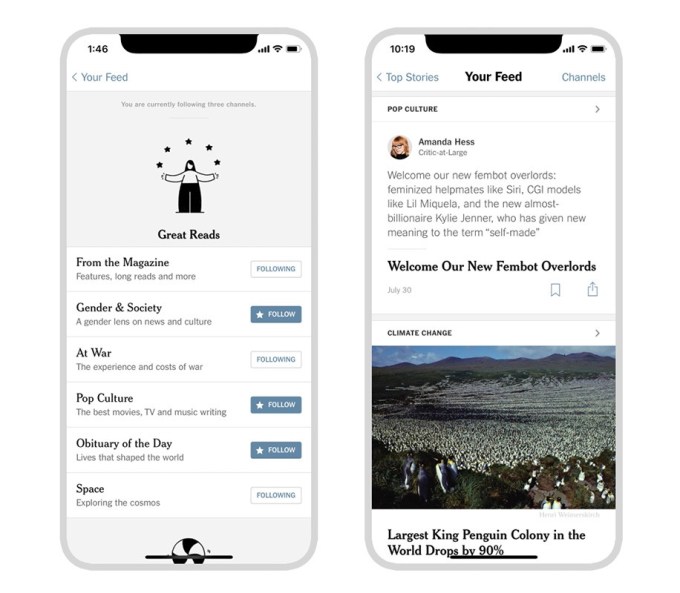
The New York Times announced on Friday how it’s adding its own take on Facebook-style News Feed to its mobile app. Yes, literally a news feed. The publication says it will now allow its iOS app users to customize their reading experience through a new feature called “Your Feed,” which consists only of those channels readers choose to follow. Some of those channels will pull stories from existing New York Times sections and columns, like Modern Love, while others, like Gender & Society, At War, Pop Culture, and more will pull news from across the paper’s sections. And others will include commentary from reporters and editors, and will feature worthy reads from outside The Times.

This additional context will only be found in this personalized Your Feed section, and is something the publication says is an experiment in terms of bringing another layer of insight to the news and stories. On the technical side, the commentary itself is actually pulled from The Times’ Slack, through the use of a bot built by backend engineer Brandon Hopkins. It basically turns Slack into the CMS for publishing these short posts to the Your Feed section of the app.

The design team equates the Your Feed reading experience to the way people tend to peruse a printed newspaper. Beyond reading the front page news, people will often pull out the sections they want to read, and then thumb through them – coming across other stories they want to read. And different readers will gravitate towards different sections and articles.

It says the idea for the feed came from its user research, where it found that many people wanted a separate place from the home page to follow a customized feed of content.
With The NYT outputting around 160 articles per day, it’s very difficult to be a comprehensive reader of the paper in its entirety, of course. But the app already allowed users to poke around in its many sections by tapping through its navigation. With the addition of a personalized feed – as on Facebook and on other social apps – there’s always the danger that people will begin to box themselves into their own news bubble. If the app’s users start skipping the front page and other key sections to hop into this own custom feed, they could potentially miss important news.

Hopefully, readers will choose to use the new Your Feed feature as something that’s additive to their overall news reading experience, and not as a stand-in for actually reading the paper itself.

Additionally, The NYT says the sections will be curated by its editors to ensure there’s a diverse selection of stories available. (Thankfully – news curation left up to A.I. and algorithms has proven time and again to be a disaster. So much so that Facebook finally gave up, and ditched its Trending news section altogether.) Plus, by having a human-programmed section, the editors can ensure not to overwhelm readers with stories.

To use the new feature, readers in the iOS app will be able to pick from one of 24 channels they want to follow – an idea that’s not too unlike the way users follow accounts on social apps like Twitter or Instagram. To then read through this section, there will now be a new space in the iOS app labeled Your Feed.

Going forward, The NYT says it will tweak the experience further by adjusting the channel selection, offering more ways to follow channels, and rolling out other features, while responding to user feedback and behavior to inform its design choices. It will also experiment with different versions of saving stories, notifications, and ways to better manage your interests in the app.

The feature is rolling out to The NYT iOS app on iPhone and iPad for the time being. User feedback will determine if it expands to more platforms, the publisher told us.

Saturday, 4 August 2018

What we know about the Note 9

Some companies keep products a closely guarded secret, like they were nuclear codes or ingredients to a popular cola. Others seem less concerned about the whole thing, as long as it keeps people talking. Based on all we’ve seen from the Galaxy Note 9 to date, it seems that Samsung falls firmly into the latter camp.

Of course, it’s key to point out that we won’t really know what the new handset is all about until its big reveal at Unpacked on Thursday. But also, we really know what it’s all about because, I mean, look at all these leaks.

That said, there’s probably still plenty of reason to pay attention to the event. Given the fact that the company opted not to wait to announce the Galaxy Tab S4 could point to even more big product announcements in the coming months.

There have been various other rumors swirling around these past few weeks and months, including a lot of speculation around a new Samsung Gear watch that could make its debut at the same event.

The Note 9, on the other hand, has all but stood up and announced its presence. In addition to your standard array of rumors, there have been a few egregious leaks on Samsung’s part, including a top executive using the new device in public and Samsung posting a promo video to YouTube.

Here’s what we know so far about the upcoming phablet.

Design/Display

By all accounts, the design language hasn’t changed much since the last generation device — in fact, that’s likely the reason DJ Koh thought he could go unnoticed using the phone. There is, however, one major tell that tipped off viewers to the fact that the executive was using something new.

Originally rumored to be located under screen, the fingerprint sensor has, indeed, been moved. This time, out, however, it’s under the camera, rather than beside it — addressing a key complaint with the Note 8’s design, which found users fumbling with the camera lens when attempting to unlock the device.

The dimensions are reportedly roughly the same here, as well. At 161.9 x 76.3 x 8.8mm, the device is marginally shorter than its predecessors, due perhaps in part to thinner bezels on the top and bottom. The display, meanwhile, is the ever so slightly larger at 6.4-inches to the 8’s 6.3.

Battery/Storage/Performance

Samsung’s made it pretty clear from the start that battery life is a primary focus for the new device. The company appeared to confirm early rumors that the handset would be sporting a 4,000mAh battery in an early teaser that openly mocked the iPhone’s relatively small offering (as is Samsung’s M.O. these days).

That’s a 700mAh jump over the Note 8’s offering, and puts the forthcoming handset toward the top of the phone battery heap. It also bucks Samsung’s recent trend of battery modesty, in the wake of the ongoing Note 7 fiasco. The company apologized profusely, instituted strict testing guidelines, and the phone buying public appears to have mostly forgiven and forgotten the whole kerfuffle.

Subsequent teasers, meanwhile, have focused on additional storage and performance enhancements. A massive 512GB version is rumored to be on tap and will no doubt cost a pretty penny. That can be augmented by up to a terrabyte, courtesy of the microSD slot.

Cameras

This is a no-brainer. Camera updates have been the focus of virtually every flagship phone release. That said, this is one of the few pieces of the phone that’s still a relative mystery.

S-Pen

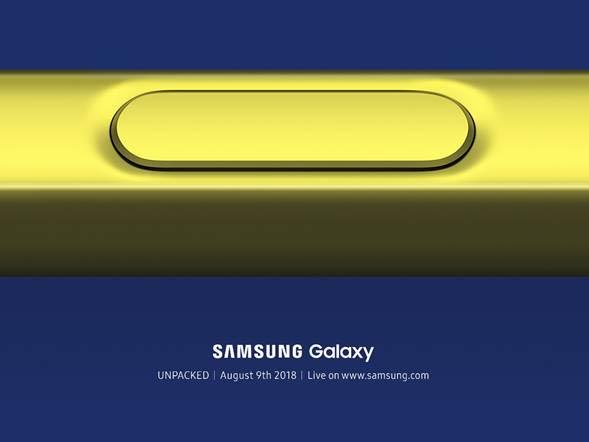
The company’s beloved stylus was clearly a focus from the outset. In fact, the Unpacked invitation shows a closeup of the S-Pen’s button on a yellow background. The new leaked video confirms the vibrant new color scheme, which, at the very least, should make it a bit harder to lose.

The company has also strongly hinted that S-Pen improvements will be a focus for the new phone, but these have mostly managed to stay under wraps. Suggested functionality includes non-drawing controls for things like music playback and remote unlock.

Headphone Jack

Yep, still here. After all, it was only a few weeks ago that the company was mocking Apple for what it perversely deemed a “double-dongle” required to listen to music and charge the phone at the same time. It remains a key differentiator between Samsung’s handsets and the iPhone, and as such, is likely sticking around for a wwhile. All of the leaks thus far appear to confirm this.

The greedy ways Apple got to $1 trillion

For being the richest company ever with $243 billion in cash, Apple sure cuts corner in the stingiest ways. The hardware giant became the first trillion-dollar company week. Yet it’s tough to reconcile Apple earning $11 billion in profit per quarter with it still screwing us over on cords and keyboards. The “it just works” philosophy has slipped through the cracks of the money-printing machine.

We still turn to Apple because it makes the best core products. But the edges of the customer experience have frayed like the wires of a Lightning cable. The key to Apple’s fortune is obviously selling high margin iPhones, not these ways it nickels and dimes us. But the company has an opportunity to raise its standards after this milestone, though, and win back the faith that could push it to a $2 trillion market cap.

1. Frayed Charging Cables

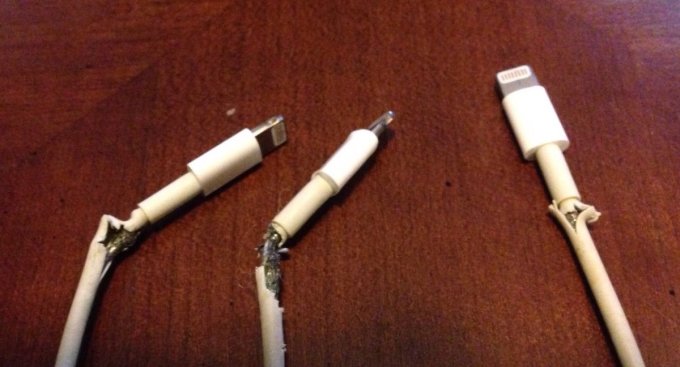
Apple gives you that tingly feeling in the worst way. Can it not build Lightning cables and MacBook chargers a little sturdier? If you avoid losing one long enough to put in some serious use, it inevitably ends up splittling where the cord meets your iPhone or exits the laptop power supply. Whether it’s wrapping them in electrical tape or the spring of a retractable pen, people have come up with all sorts of Macgyver methods to make their Apple chargers last. It got so bad that Apple was sued into offering a MacBook charger replacement program, but that expired years ago. If these are what allow us to play with the fancy devices it invents, shouldn’t they get the same quality of industrial design?

Image via Sophia Cannon

2. Buried iTunes Subscriptions Cancellation

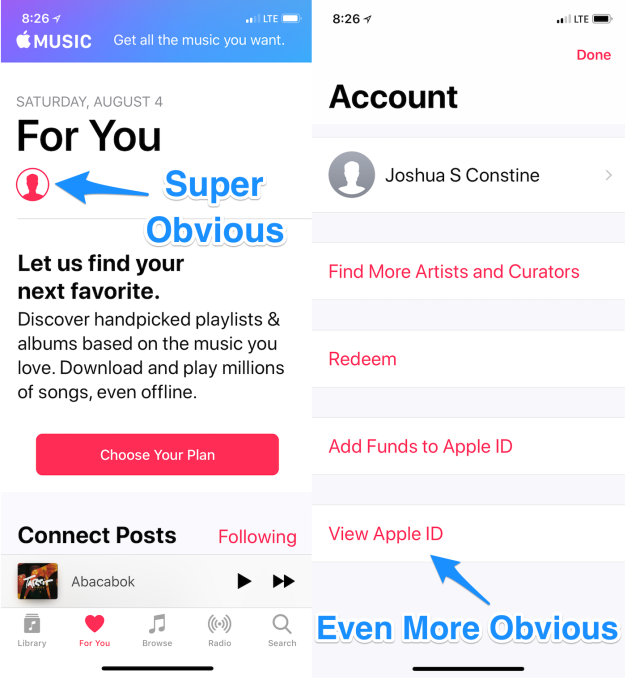
Want to cancel your Apple Music subscription or some other service you got roped into with a free trial? It’s SUPER easy. First, click the totally unlabeled and generic circle with a blotch in it that’s supposed to be a profile picture icon. You should see a “Manage Subscriptions” option…but you don’t. Instead, you’ll have to know to tap “View Apple ID”. Once you auth in with the same face or thumbprint that opened your phone in the first place you’ll find the option to cut them off. And as thank you for this convenience, you’ll get to pay 30 percent extra on some subscriptions if you pay through Apple. It’s clearly exploitative dark pattern design.

3. Keyboard Claptrap

The MacBook keyboard is the on-ramp to the information superhighway, yet a single grain of sand can cause a pile up. Renowned Apple pundit John Gruber called it “one of the biggest design screwups in Apple history”. The new butterfly key design Apple rolled out in 2016 can get jammed by dust, requiring a lengthy disassembly process often requiring a professional to fix. Suddenly your work grinds to a halt. Apple wouldn’t always cover this repair, even under warranty. It took a lawsuit and tons of public backlash for Apple to offer free fixes, and that still typically leaves you without a laptop for a few days. I’m typing this article on a cracked-screen 2013 MacBook Pro because I refuse to upgrade until they make the keyboard design more resilient.
4. Killing Affiliate Fees Blogs Rely On

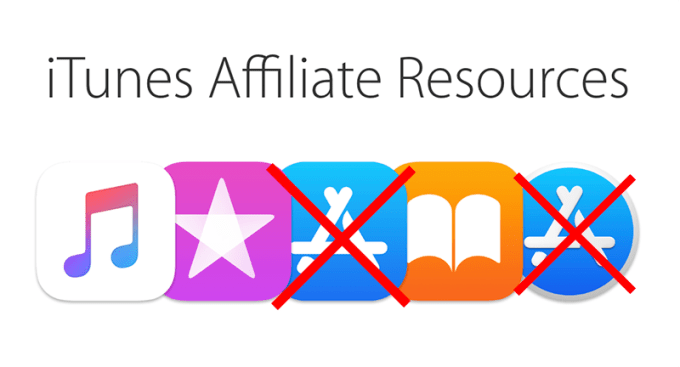
Apple benefits from a legion of blogs obsessing over its hardware and software, hyping up everything it sells. Just this week it returned that favor by announcing it will cut off one of their core sources of revenue. Websites would previously earn a 7 percent commission from Apple in exchange for affiliate link clicks leading to purchases on the App Store. But over the past few years, Apple has begun to sell ads inside the App Store too, competing for advertisers with those external blogs. It’s also built up its own editorial team that curates what’s featured, and apparently doesn’t want competition in being a king-maker. So in October Apple is shutting down the affiliate program that app review sites like TouchArcade and AppShopper depend on, potentially spelling their doom.

5. Dongle Hell

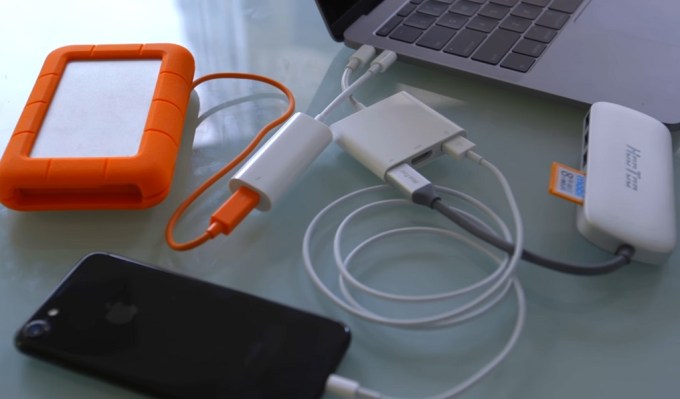
What’s the opposite of “it just works”? Paying extra to lug around a slew of gangly cord connectors you need just to plug things into your laptop or phone. Dongles are the emblem of Apple’s abandonment of the user experience. A Thunderbolt 2 to Thunderbolt 3 dongle runs $50 while it will cost you $9 to plug in any pair of headphones from the past half-century once you’ve inevitably lost the Lightning dongle you’re allocated. Apple loves pushing us towards its vision of tomorrow, like Bluetooth headphones (that it sells) and USB-C fast-chargers (that it sells). But ditching headphone jacks and old school USB ports makes Apple’s latest devices incompatible with sanity. Even its own commercial shows musician Grimes struggling with her dongles. Sorry you can’t pass me the aux cord. I’m from the future.

Image via Notebookcheck

[Featured Image via Instructibles]

Friday, 3 August 2018

Goodly looks to give companies student loan payments as an employee benefit

As employers duke it out over hiring the best possible candidates, especially ones coming out of school, they are starting to get a little bit more creative with their incentive packages — and that includes offering an option for paying down student debt.

Goodly is a new startup that’s looking to help those employers offer that as a benefit. Smaller companies without the resources to create complicated incentive packages especially need tools that help shortcut the process of offering those benefits. It’s following a similar playbook of companies looking to make it easier to get the tools they need in place and focus more on the set of products that are going to make it an actually differentiated company. Goodly is launching out of Y Combinator’s summer class this year.

“We found it to be a really great tool for recruiting and retaining,” co-founder Gregory Poulin said. “When people hear student loan benefits, they instantly think it’s very expensive. You can offer student loan benefits starting $25 to $50 per employee per month, up to $200. Our system is completely flexible. You can offer any company size for any budget. You can offer meaningful benefit for less than the cost of a cup of coffee a day. For the average borrower, when they have an employer contributing an extra $100 per months, it could help your average employee get out of debt almost a decade faster.”

There are more common benefits like stock packages, 401(k) matches, insurance, better time off policies, or others along those lines. But as student debt increasingly becomes a factor in a candidate’s decision on where they work, it’s another way that companies — ones without larger compensation packages or very aggressive recruiting operations like, say, Google or Facebook — can still get the attention and interest of good candidates coming out of school. Like other companies (like Human Interest for 401(k)s, for example), the goal is to make it easy to get started and maintain the whole process.

Employees connect their student loans to Goodly, which takes a few minutes to verify them before setting up the contribution plan. Goodly integrates with payroll operations and gives companies and employees a pretty flexible way to set their spending schedule. Then, it goes from there, without the employees having to manage it on a per-period basis. While it might have the robust tax incentives in place like a retirement plan, it’s still a way to help companies offer some way of showing employees that they’re invested in their employees’ future success, which is another way that those companies might be able to retain that talent. Goodly then brings back detailed reports on the company’s implementation to help it better understand whether the policies are working for their employees.

It’s certainly an area that’s attracted interest — and funding — from a number of startups like Tuition.io which look to help employers get a little more creative about their benefits. Much like contributions to retirement plans, it’s another way to offer employees a way to invest in their future by reducing the financial stress they have through some of their biggest financial decisions like where to go for college. Poulin also said it’s a way to help discover a more diverse talent pool as it surfaces up underrepresented parts of the population that are acutely dealing with student debt as a factor in their decision-making.

Portal offers an easy way to pay creators for their content

Portal founder Jonathan Swerdlin is just the latest media pundit to point to advertising as the root cause of the industry’s problems. But he’s not content to diagnose the illness — he thinks he’s created a cure.

“Digital media has become toxic, in part, because of advertising,” Swerdlin said. “The unmet and unarticulated need is a peer-to-peer economy where you’re rewarded for creating value, rather than a quantity model” where a publisher or creator’s main economic incentive is to attract as many eyeballs as possible.

Naturally, that’s what Swerdlin is trying to offer in Portal. When you open the app, you follow creators and topics that interest you, then get presented with a feed of videos. During or after the video, you can tip the creator in Portal coins — the current price is 1 cent per coin, and individual payments can be anything from 10 to 10,000 coins.

This changes the equation for creators. If you’re monetizing a video with ads, 1,000 views would represent a negligible amount of ad revenue — but if 1,000 people like the video and are willing to pay a dollar, then then you’re starting to talk about real money.

Conversely, there’s no financial incentive to post a video on Portal that gets a million views if everyone’s going to think it’s a complete waste of their time.

Jonathan Swerdlin

Swerdlin said removing advertising changes the incentives for Portal too, because the startup doesn’t benefit from promoting content just because it’ll get clicks.

In fact, he said Portal will pretty allow users to post anything, as long as it doesn’t violate community standards around things like pornography and hate speech. And it presents a purely reverse chronological feed of content based on what you follow — the question of surfacing interesting content in the feed will probably get more complicated as more users join the platform, but Swerdlin argued, “We don’t need algorithms to solve feed problems.”

“We’re not going to bury things that are not advertiser-friendly,” he added. “It’s a very different game. Portal is very much about people having a place to freely express themselves and not worry about being buried by an algorithm.”

Swerdlin acknowledged that these aren’t entirely new ideas or strategies — micropayments have been touted as a solution to media monetization for years, and he pointed to services like Netflix and Medium as offering models that help creators “break free of advertising.”

At the same time, Swerdlin said Portal’s approach to payments is truly offers “no friction” — it’s uses your App Store payment info, so you don’t even need to enter your credit information. He also said that by creating an app for content (rather than just a micropayment platform that plugs into existing websites), Portal can truly solving the problem by offering a media environment that’s “safe, it’s a healthy media diet, as opposed ot the juunk food.”

Currently, Portal’s content is limited to videos, but those videos cover a range of topics and genres like advice (personal- and business-related), comedy, music and personal vlogging. Over time, Swerdlin wants to expand to other content formats.

You also need an invite code to access the app, but if you want to try it out, feel free to use mine: “anthonyha”. (Don’t blame me; I didn’t choose it.)

Tim Cook to Apple staff: $1TR in shareholder value isn’t what drives us

How should you feel to know your employer is far, far richer than Croesus?

As Apple CEO Tim Cook tells it — in a memo to staff, obtained by BuzzFeed News, re: yesterday’s news that the computer company Steve Jobs founded back in 1976 is now worth more than $1,000,000,000,000 — you should feel A) pretty stoked that your labor has helped achieve a significant financial milestone but also B) know it’s not a success metric to get hung up about because it’s the passion for innovation and creation (not the towering mounds of gold) that really counts and so C) please, after taking a moment, remember to get back to work.

Here’s what Cook actually wrote to Apple’s global “team” of circa 123,000 employees:

Team,

Today Apple passed a significant milestone. At our closing share price of $207.39, the stock market now values Apple at more than $1 trillion. While we have much to be proud of in this achievement, it’s not the most important measure of our success. Financial returns are simply the result of Apple’s innovation, putting our products and customers first, and always staying true to our values.

It’s you, our team, that makes Apple great and our success is due to your hard work, dedication and passion. I am deeply humbled by what you do, and it’s the privilege of a lifetime to work alongside you. I want to thank you from the bottom of my heart for all the late hours and extra trips, all the times you refuse to settle for anything less than excellence in our work together.

Let’s take this moment to thank our customers, our suppliers and business partners, the Apple developer community, our coworkers and all those who came before us at this remarkable company.

Steve founded Apple on the belief that the power of human creativity can solve even the biggest challenges — and that the people who are crazy enough to think they can change the world are the ones who do. In today’s world, our mission is more important than ever. Our products not only create moments of surprise and delight, they empower people all around the globe to enrich their lives and the lives of others.

Just as Steve always did in moments like this, we should all look forward to Apple’s bright future and the great work we’ll do together.

Tim

Samsung’s official launch video for the Galaxy Note 9 has also now leaked…

The official launch promo video for Samsung’s next flagship smartphone in the long-running Galaxy Note line — the Note 9 — appears to have leaked, with links to the video now cropping up on YouTube.

And via Twitter…

The forthcoming phablet has been pretty comprehensively leaked already. And clearly hasn’t had a radical (cosmetic nor form factor) makeover. (This is not the fabled folding phone Samsung is slated to be working on for next year.)

The Note 9 will also be officially unveiled on August 9. So Samsung fans don’t have long left to wait for any last minute details they were keen to nail down.

But, in the few days remaining, the Samsung-branded video offers a more polished look at what’s going to be up for pre-order next week…

Samsung kicks off touting the power of the Note 9 — telling us it’s not just powerful but “super powerful” (leaked benchmarks have previously suggested a big performance boost); and with a bottoms-up ports & rear view pan that shows a 3.5mm headphone jack sitting in the frame — confirming my TC colleague Brian Heater’s eagle eye.

Also of note: A repositioned fingerprint sensor (now in a less stupid location below the dual lens camera housing).

Next, the video flips focus to a snazzy yellow (or is that gold?) S Pen stylus, which Samsung describes as “all new powerful”, before showing its physical button being pressed by an invisible force (human, we hope) which then does a spot of aimless doodling.

After this, Samsung moves to brag about the Note 9’s “all day battery” (which it’s confidently teased before — so the company looks to have put the Note 7 battery fiasco well and truly behind it), although the usual small print disclaimers warn about variable battery performance.

On the storage front, there’s a big bold claim of the device being “1 terabyte ready” — although this is on account of a 512GB SD card shown being pulled out of the expandable memory slot.

And in the small print displayed on the video at that point the company caveats that the 1TB claim is for 512GB models equipped with another 512GB in expandable memory (at the owner’s separate expense).

“The power to store more” [photos] “Delete less” [photos] is what the company’s marketing team has come up with to try to excite people over the utility of owning a smartphone that can have 1TB in storage capacity. i.e. if you stump up extra for the extra storage.

The video shows a camera roll chock-full of stock photos of pets, snacks and people. Hopefully Note 9 owners will find more creative things to do with 1TB storage.

Thursday, 2 August 2018

The Moto Z3 will get 5G via mod

Say what you will about the success or general usefulness of the Moto Mod line — Motorola keeps plugging away. The company currently offers 17 Mods with an 18th on the way, bringing one of the most interesting case uses yet.

Along with the new Moto Z3 handset, Motorola unveiled a Mod that will bring 5G connectivity to the entire line via Verizon’s nascent network. Due out early  next year for an undisclosed sum, the new Mod presents an interesting work around to the pains of introducing a next generation network to a handset.

With this backdoor approach, the company is able put the Z3 up for sale on August 16th, and work another half-year or so to get its ducks in a row on the 5G front. Perhaps Verizon’s 5G coverage map will be a bit more dense by then, though at present, the company has only announced three cities — Houston, Los Angeles and, oddly, Sacremento. A fourth unnamed city is also on tap to get coverage by end of year.

At very least, this lets Motorola tout the claim of being one of — if not the — first phones to offer the technology to U.S. customers. The company also claims that putting this tech directly into the phone would have been much more resource intensive than just sticking it and an extended battery inside the mod.

I’m not sure how much I buy that line of reasoning, but it certainly helps keep the cost of the handset down — the new Z3 will be available for $480 unlocked. The company has long focused on providing budget options for users, and that’s certainly the case here, helped along by some good — but last generation — silicon like the Snapdragon 835. 

Motorola also likely didn’t feel confident that most users would be willing to take the plunge on a 5G phone at this early stage. As for the phone itself, it looks pretty similar to the recently introduced Moto Z3 Play in most respects. There’s a six-inch display, a 3,000mAh battery and dual-cameras with depth sensing and Google lens built in.  No word yet on whether Verizon will eventually bundle the phone with that new Mod.

Disclosure: Verizon owns Oath, Oath owns TechCrunch.

UK report highlights changing gadget habits — and our need for an online fix

A look back at the past decade of consumer technology use in the UK has shone a light on changing gadget habits, underlining how Brits have gone from being smartphone dabblers back in 2008 when a top-of-the-range smartphone cost ~£500 to true addicts in today’s £1k+ premium smartphone era.

The report also highlights what seems to be, at times, a conflicted relationship between Brits and the Internet.

While nine in ten people in the UK have home access to the Internet, here in 2018, some web users report feeling being online is a time-sink or a constraint on their freedom.

But even more said they feel lost or bored without it.

Over the past decade the Internet looks to have consolidated its grip on the spacetime that boredom occupied for the less connected generations that came before.

The overview comes via regulator Ofcom’s 2018 Communications Market report. The full report commenting on key market developments in the country’s communications sector is a meaty, stat and chart-filled read.

The regulator has also produced a 30-slide interactive version this year.

Commenting on the report findings in a statement, Ian Macrae, Ofcom’s director of market intelligence, said: “Over the last decade, people’s lives have been transformed by the rise of the smartphone, together with better access to the Internet and new services. Whether it’s working flexibly, keeping up with current affairs or shopping online, we can do more on the move than ever before.

“But while people appreciate their smartphone as their constant companion, some are finding themselves feeling overloaded when online, or frustrated when they’re not.”

We’ve pulled out some highlights from the report below…

  • Less than a fifth (17%) of UK citizens owned a smartphone a decade ago; the figure now stands at 78% — and a full 95% of 16-24 year-olds. So, yeah, kids don’t get called digital natives for nothin’
  • People in the UK check their smartphones, on average, every 12 minutes of the waking day. (‘Digital wellbeing’ tools clearly have their work cut out to kick against this grain… )
  • Ofcom found that two in five adults (40%) first look at their phone within five minutes of waking up (rising to 65% of the under 35s). While around a third (37%) of adults check their phones five minutes before lights out (again rising to 60% of under-35s). Shame it didn’t also ask how well people are sleeping
  • Contrary to a decade ago, most UK citizens say they need and expect a constant Internet connection wherever they go. Two thirds of adults (64%) say it’s an essential part of their life. One in five adults (19%) say they spend more than 40 hours a week online, up from 5% just over ten years ago
  • Three quarters (74%) of people say being online keeps them close to friends and family. Two fifths (41%) say it enables them to work more flexibly

Smartphone screen addicts, much?

  • Seventy-two per cent of adults say their smartphone is their most important device for accessing the Internet; 71% say they never turn off their phone; and 78% say they could not live without it
  • Ofcom found the amount of time Brits spend making phone calls from mobiles has fallen for the first time — using a mobile for phone calls is only considered important by 75% of smartphone users vs 92% who consider web browsing on a smartphone to be important (and indeed the proportion of people accessing the Internet on their mobile has increased from 20% almost a decade ago to 72% in 2018)
  • The average amount of time spent online on a smartphone is 2 hours 28 minutes per day. This rises to 3 hours 14 minutes among 18-24s

Social and emotional friction, plus the generation gap…

  • On the irritation front, three quarters of people (76%) find it annoying when someone is listening to music, watching videos or playing games loudly on public transport; while an impressive 81% object to people using their phone during meal times
  • TV is another matter though. The majority (53%) of adults say they are usually on their phone while watching TV with others. There’s a generation gap related to social acceptance of this though: With a majority (62%) of people over the age of 55 thinking it’s unacceptable — dropping to just two in ten (21%) among those aged 18-34
  • Ofcom also found that significant numbers of people saying the online experience has negative effects. Fifteen per cent agree it makes them feel they are always at work, and more than half (54%) admit that connected devices interrupt face-to-face conversations with friends and family — which does offer a useful counterpoint to social media giant’s shiny marketing claims that their platforms ‘connect people’ (the truth is more they both connect & disconnect). While more than two in five (43%) also admit to spending too much time online
  • Around a third of people say they feel either cut off (34%) or lost (29%) without the Internet, and if they can’t get online, 17% say they find it stressful. Half of all UK adults (50%) say their life would be boring if they could not access the Internet 
  • On the flip side, a smaller proportion of UK citizens view a lack of Internet access in a positive light. One in ten says they feel more productive offline (interestingly this rises to 15% for 18-34 year-olds); while 10% say they find it liberating; and 16% feel less distracted

The impact of (multifaceted and increasingly powerful and capable) smartphones can also be seen on some other types of gadgets. Though TV screens continue to compel Brits (possibly because they feel it’s okay to keep using their smartphones while sitting in front of a bigger screen… )

  • Ofcom says ownership of tablets (58% of UK households) and games consoles (44% of UK adults) has plateaued in the last three years
  • Desktop PC ownership has declined majorly over the past decade — from a large majority (69%) of households with access in 2008 to less than a third (28%) in 2018
  • As of 2017, smart TVs were in 42% of households — up from just 5% in 2012
  • Smart speakers weren’t around in 2008 but they’ve now carved out a space in 13% of UK households
  • One in five households (20%) report having some wearable tech (smart watches, fitness trackers). So smart speakers look to be fast catching up with fitness bands

BBC mightier than Amazon

  • BBC website visitor numbers overtook those of Amazon in the UK in 2018. Ofcom found the BBC had the third-highest number of users after Google and Facebook
  • Ofcom also found that six in ten people have used next-day delivery for online purchases, but only three in ten have used same-day delivery in 2018. So most Brits are, seemingly, content to wait until tomorrow for ecommerce purchases — rather than demanding their stuff right now

What else are UK citizens getting up to online? More of a spread of stuff than ever, it would appear…

  • Less general browsing/surfing than last year, though it’s still the most popular reported use for Internet activity (69% saying they’ve done this in the past week vs 80% who reported the same in 2017)
  • Sending and receiving email is also still a big deal — but also on the slide (66% reporting doing this in the past week vs 76% in 2017)
  • Social media use is another popular but slightly less so use-case than last year (50% in 2017 down to 45% in 2018). (Though Twitter bucks the trend with a percentage point usage bump (13% -> 14%) though it’s far less popular overall)
  • Instant messaging frequency also dropped a bit (46% -> 41%)
  • As did TV/video viewing online (40% -> 36%), including for watching short video clips (31% to 28%)
  • Online shopping has also dropped a bit in frequency (48% -> 44%)
  • But accessing news has remained constant (36%)
  • Finding health information has seen marginal slight growth (22% -> 23%); ditto has finding/downloading information for work/college (32% -> 33%); using local council/government services (21% -> 23%); and playing games online/interactively (17% -> 18%)
  • Streaming audio services have got a bit more popular (podcasts, we must presume), with 15% reporting using them in the past week in 2017 up to 19% in 2018. Listening to the radio online is also up (13% -> 15%)
  • However uploading/adding content to the Internet has got a bit less popular, though (17% to 15%)

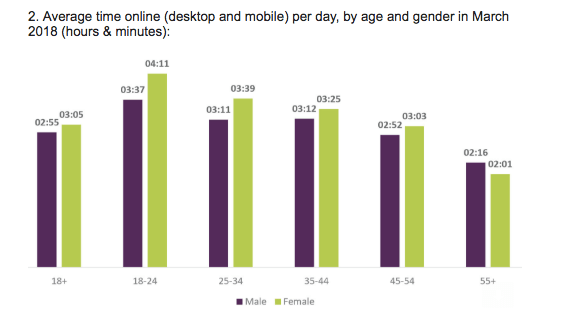
One more thing: Women in the UK are bigger Internet fans than men.

Perhaps contrary to some people’s expectations, women in the UK spend more time online on average than men across almost all age groups, with the sole exception being the over 55s (where the time difference is pretty marginal)…

Instagram’s CEO on vindication after 2 years of reinventing Stories

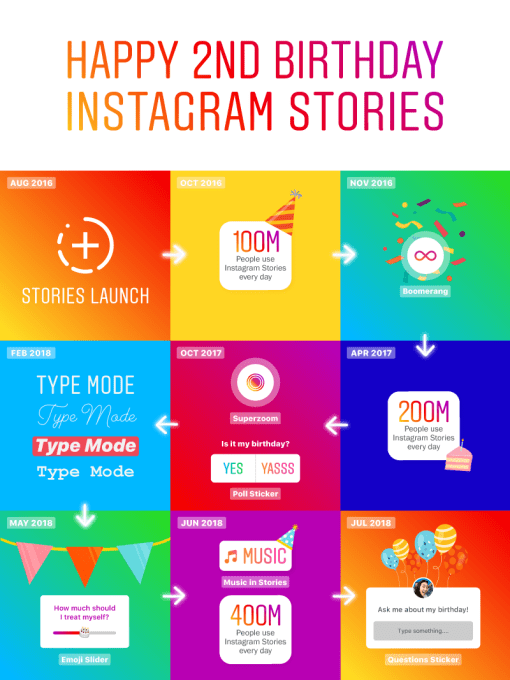
“I think the mistake everyone made was to think that Stories was a photography product” says Instagram CEO Kevin Systrom. “If you look at all these interactivity features we’ve added, we’ve really made Stories something else. We’ve really innovated and made it our own.”

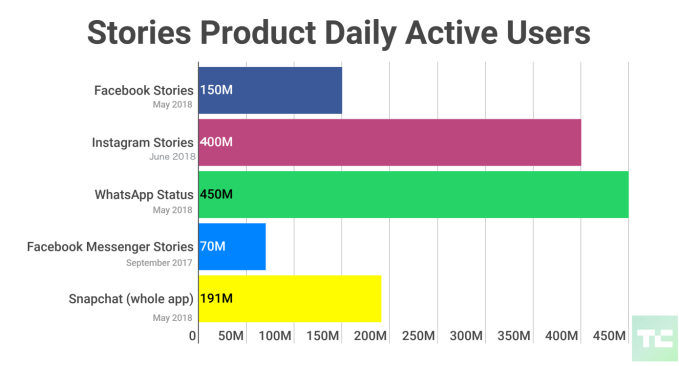
His version of the ephemeral slideshow format turns two years old today. By all accounts, it’s a wild success. Instagram Stories has 400 million daily users, compared to 191 million on Snapchat which pioneered Stories. While the first year was about getting to parity with augmented reality filters and stickers, the two have since diverged. Instagram chose the viral path.

Snapchat has become more and more like Photoshop, with its magic eraser for removing objects, its green screen-style, background changer, scissors for cut-and-pasting things, and its fill-in paint bucket. These tools are remarkably powerful for living in a teen-centric consumer app. But many of these artistic concepts are too complicated for day-to-day Snapping. People don’t even think of using them when they could. And while what they produce is beautiful, they get tapped past and disappear just like any other photo or video.

Instagram could have become Photoshop. Its early photo-only feed’s editing filters and sliders pointed in that direction. Instead, it chose to focus not on the “visual” but the “communication”. Instagram increasingly treats Stories as a two-way connection between creators and fans, or between friends. It’s not just one-to-many. It’s many-to-one as well.

Instagram Stories arrived three years after Snapchat Stories, yet it was the first to let you tag friends so they’d get a notification. Now those friends can repost Stories you tag them in, or public posts they want to comment on. You could finally dunk on other Instagrammers like you do with quote-tweets. It built polls with sliders friends can move to give you feedback about “how ridiculous is my outfit today?” And most recently, it launched the Question sticker so you can query friends through your Story and then share their answers there too. Suddenly, anyone could star in their own “Ask Me Anything”.

Mimicking Photoshop reinforces the idea that everything has to look polished. That’s the opposite of what Systrom was going for with the launch of Instagram Stories. “There will always be an element in any public broadcast system of trying to show off” Systrom explains. “But what I see is it moving in the other direction. GIF stickers allow you to be way more informal than you used to be. Type mode means now people are just typing in thoughts rather than actually taking photos. Things like Superzoom with the TV effect or the beats — it’s anything but polished. If anything it’s a joke. Quantitatively people feel comfortable to post way more stories than to feed.”

That sense of comfort powered by Instagram purposefully pushing Stories to diverge from its classy feed has contributed to its explosion in popularity — not just for Stories but Instagram as a whole. It now has over 1 billion users, in part driven by it introducing Stories to developing countries Snapchat never penetrated.

“Remember how at the launch of Stories, I said it was a format and we want to make it original? And there was a bunch of criticism around us adopting this format? My response was this is a format and we’re going to innovate and make it our own. The whole idea there is to make it not just about photography but about expression. It’s a canvas for you to express yourself.”

Last week when Facebook announced its revenue was decelerating as users shifted attention from its lucrative News Feed to Stories, its share price tanked deleting $120 billion in market cap. Yet imagine how much further it would have dropped if Systrom hadn’t been willing to put his pride aside, take Snapchat Stories, and give it the Insta spin? Instead, it led the way to Facebook now having over 1.1 billion (duplicated) daily Stories users across its apps

So does he feel vindicated in that once-derided decision? “I don’t wake up everyday trying to feel vindicated. I wake up everyday trying to make sure our billion users have amazing stuff to use. I just feel lucky that they love what we produce” Systrom says with a laugh. “I don’t know if that fits your definition of vindicated.”

Wednesday, 1 August 2018

WhatsApp finally earns money by charging businesses for slow replies

Today WhatsApp launches its first revenue-generating enterprise product and the only way it currently makes money directly from its app. The WhatsApp Business API is launching to let businesses respond to messages from users for free for up to 24 hours, but will charge them a fixed rate by country per message sent after that.

Businesses will still only be able to message people who contacted them first, but the API will help them programatically send “shipping confirmations, appointment reminders or event tickets. Clients can also use it respond to manually respond to customer service inquiries through their own tool or apps like Zendesk or Twilio.

After getting acquired by Facebook for $19 billion in 2014, it’s finally time for the 1.5 billion-user WhatsApp to pull its weight and contribute some revenue. If Facebook can pitch the WhatsApp Business API as a cheaper alternative to customer service call centers, the convenience of asynchronous chat could compel users to message companies instead of phoning.

Only charging for slow replies after 24 hour is a genius way to create a growth feedback loop. If users get quick answers via WhatsApp, they’ll prefer it other channels. Once businesses and their customers get addicted to it, WhatsApp could eventually charge for all replies or any that exceed a volume threshold, or cut down the free window. Meanwhile, businesses might be too optimistic about their response times and end up paying more often than the expect, especially when messages come in on weekends or holidays.

WhatsApp first announced it would eventually charge for enterprise service last September when it launched its free WhatsApp For Business app that now has 3 million users and will still let smaller companies manually reply to messages one-by-one. That app now has 3 million users.

Importantly, WhatsApp stresses that all messaging between users and businesses, even through the API, will be end-to-end encrypted. That contrasts with the Washington Post’s report that Facebook pushing to weaken encryption for WhatsApp For Business message is partly what drove former CEO Jan Koum to quit WhatsApp and Facebook’s board in April. His co-founder Brian Acton had ditched Facebook back in September and donated $50 million to the foundation of encrypted messaging app Signal.

Today WhatsApp is also formally launching its new display ads product worldwide. But don’t worry, they won’t be crammed into your chat inbox like with Facebook Messenger. Instead, businesses will be able to buy ads on Facebook’s News Feed that launch WhatsApp conversations with them…thereby allowing them to use the new Business API to reply. TechCrunch scooped that this was coming last September, when code in Facebook’s ad manager revealed the click-to-WhatsApp ads option, and the company confirmed the ads were in testing. Facebook launched similar click-to-Messenger ads back in 2015.

Together, the ads and API will replace the $1 per year subscription fee WhatsApp used to charge in some countries but dropped in 2016. With Facebook’s own revenue decelerating, triggering a 20 percent, $120 billion market cap drop in its share price, it needs to show it has new ways to make money now more than ever.

Facebook and Instagram now show how many minutes you use them

It’s passive zombie feed scrolling, not active communication with friends that hurts our health, according to studies Facebook has been pointing to for the last seven months. Yet it’s treating all our social networking the same with today’s launch of its digital wellbeing screentime management dashboards for Facebook and Instagram in the US before rolling them out to everyone in the coming weks.

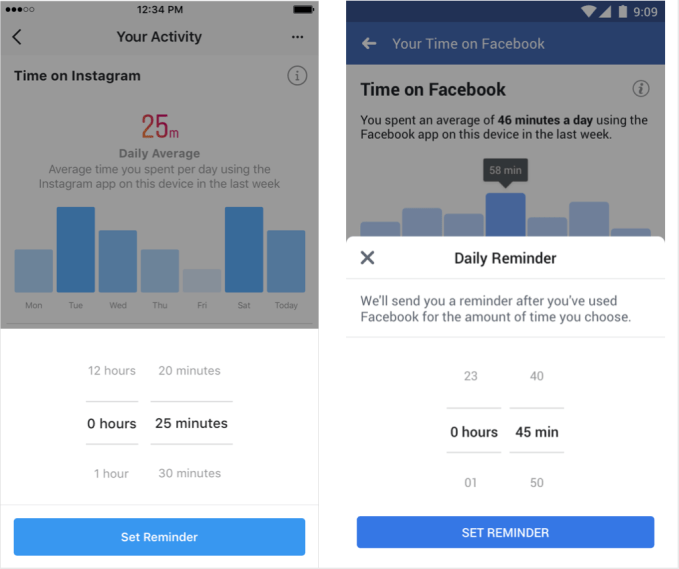
Giving users a raw count of the minutes you’ve spent in their apps each day in the last week plus your average across the week is a good start to making users more mindful. But by burying them largely out of sight, giving them no real way to compel less usage, and not distinguishing between passive and active behavior, they seem destined to be ignored while missing the point the company itself stresses.

TechCrunch scooped the designs of the two separate but identical Instagram and Facebook tools over the past few months thanks to screenshots generated from the apps’ code by Jane Manchun Wong. What’s launching today is what we saw, with the dashboards located in Facebook’s “Settings” -> “Your Time On Facebook” and Instagram’s “Settings” -> “Your Activity”.

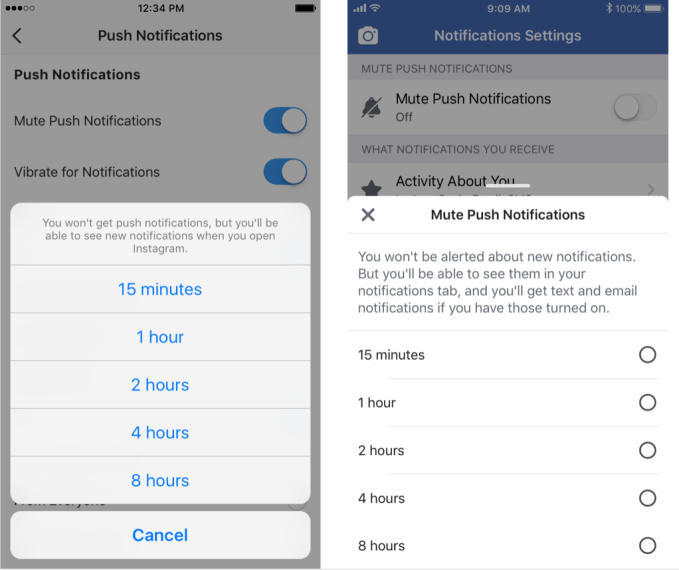
Beyond the daily and average minute counts, you can set a daily “limit” in minutes after which either app will send you a reminder that you’ve crossed your self-imposed threshold. But they won’t stop you from browsing and liking, or force you to dig into the settings menu to extend your limit. You’ll need the willpower to cut yourself off. The tools also let you mute push notifications (you’ll still see in-app alerts), but only for as much as 8 hours. If you want anything more permanent, you’ll have to dig into their separate push notification options menu or your phone’s settings.

The announcement follows Instagram CEO Kevin Systrom’s comments about our original scoop, where he tweeted “It’s true . . . We’re building tools that will help the IG community know more about the time they spend on Instagram – any time should be positive and intentional . . . Understanding how time online impacts people is important, and it’s the responsibility of all companies to be honest about this. We want to be part of the solution. I take that responsibility seriously.”

The apps will provide callouts to users teaching them about the tools. Facebook says it has no plans to use whether you open the tools or set daily limits to target ads. It will track how people use the tool to give it more in

“It’s really important for people who use Instagram and Facebook that the time they spend with us is time well spent” Ameet Ranadive, Instagram’s Product Director of Well-Being, told reporters on a conference call. “There may be some tradeoff with other metrics for the company and that’s a tradeoff we’re willing to live with, because in the longer term we think this is important to the community and we’re willing to invest in it.”

Facebook has already felt some of the brunt of the tradeoff. It’s been trying to improve digital wellbeing by showing fewer low quality viral videos and clickbait news stories, and more from your friends. That’s contributed to a flatlining of its growth in North America, and even a temporary drop of 700,000 users while it also lost 1 million users in Europe this past quarter. That led to Facebook’s slowest user growth rates in history, triggering a 20 percent, $120 billion market cap drop in its share price. “The changes to the News Feed back in January were one step . . . giving people a sense of their time so they’re more mindful of it is the second step” says Ranadive.

The fact that Facebook is willing to put its finances on the line for digital wellbeing is a great step. But it’s likely to be changes to the Facebook and Instagram feeds that prioritize content you’ll comment on rather than look at and silently scroll past that will contribute more to healthy social networking than today’s toothless tools.

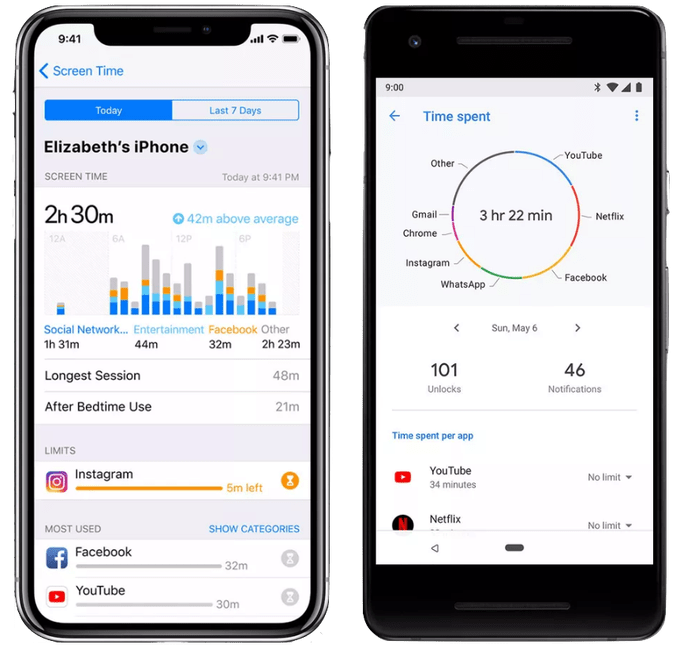
iOS Screen Time (left) and Android Digital Wellbeing (right)

While iOS 12’s Screen Time and Android’s new Digital Wellbeing features both count your minutes on different apps too, they offer more drastic ways to enforce your own good intentions. iOS will deliver a weekly usage report to remind you the features exist. Android’s is best-in-class because it grays out an app’s icon and requires you to open your settings to unlock an app after you exceed your daily limit.

To live up to the responsibility Systrom promised, Facebook and Instagram will have to do more to actually keep us mindful of the time we spend in their apps and help us help ourselves.