Everything Apple

Wednesday, 30 May 2018

Here’s Mary Meeker’s essential 2018 Internet Trends report

Want to understand all the most important tech stats and trends? Legendary venture capitalist Mary Meeker has just released the 2018 version of her famous Internet Trends report. It covers everything from mobile to commerce to the competition between tech giants. Check out the full report below, and we’ll add some highlights soon. Then come back for our slide-by-slide analysis of the most important parts of the 294 page report.

  • Internet adoption: As of 2018, half the world population, or about 3.6 billion people, will be on the internet. That’s thanks in large part to cheaper Android phones and Wifi becoming more available, though individual services will have a tougher time adding new users as the web hits saturation.
  • Mobile usage: While smartphone shipments are flat and internet user growth is slowing, U.S. adults are spending more time online thanks to mobile, clocking 5.9 hours per day in 2017 versus 5.6 hours in 2016.
  • Mobile ads: People are shifting their time to mobile faster than ad dollars are following, creating a $7 billion mobile ad opportunity, though platforms are increasingly responsible for providing safe content to host those ads.
  • Crypto: Interest in cryptocurrency is exploding as Coinbase’s user count has nearly quadrupled since January 2017
  • Voice: Voice technology is at an inflection point due to speech recognition hitting 95% accuracy and the sales explosion for Amazon Echo which went from over 10 million to over 30 million sold in total by the end of 2017.
  • Daily usage – Revenue gains for services like Facebook are tightly coupled with daily user growth, showing how profitable it is to become a regular habit.
  • Tech investment: We’re at an all-time high for public and private investment in technology, while the top six public R&D + capex spenders are all technology companies.

Mary Meeker, analyst with Morgan Stanley, speaks during the Web 2.0 Summit in San Francisco, California, U.S., on Tuesday, Nov. 16, 2010. This year’s conference, which runs through Nov. 17, is titled “Points of Control: The Battle for the Network Economy.” Photographer: Tony Avelar/Bloomberg via Getty Images

  • Ecommerce vs Brick & Mortar: Ecommerce growth quickens as now 13% of all retail purchases happen online and parcel shipments are rising swiftly, signaling big opportunities for new shopping apps.
  • Amazon: More people start product searches on Amazon than search engines now, but Jeff Bezos still relies on other surfaces like Facebook and YouTube to inspire people to want things.
  • Subscription services: They’re seeing massive adoption, with Netflix up 25%, The New York Times up 43%, and Spotify up 48% year-over-year in 2017. A free tier accelerates conversion rates.
  • Education: Employees seek retraining and education from YouTube and online courses to keep up with new job requirements and pay off skyrocketing student loan debt.
  • Freelancing: Employees crave scheduling and work-from-home flexibility, and internet discovery of freelance work led it to grow 3X faster than total workforce growth. The on-demand workforce grew 23% in 2017 driven by Uber, Airbnb, Etsy, Upwork, and Doordash.
  • Transportation: People are buying fewer cars, keeping them longer, and shifting transportation spend to rideshare, which saw rides double in 2017.
  • Enterprise: Consumerization of the enterprise through better interfaces is spurring growth for companies like Dropbox and Slack.
  • China: Alibaba is expanding beyond China with strong gross merchandise volume, though Amazon still rules in revenue.
  • Privacy: China has a big opportunity as users there are much more willing to trade their personal data for product benefits than U.S. users, and China is claiming more spots on the top 20 internet company list while making big investments in AI.
  • Immigration: It is critical to a strong economy, as 56% of top U.S. companies were founded by a first- or second-generation immigrant.

Google Fi adds support for the Moto G6, LG’s G7 and V35 phones

Project Fi, Google’s wireless service, is getting support for a number of new phones today. Until now, if you wanted to switch to Fi, the only officially supported phones were Google’s own Pixel and Pixel 2 phones, the Nexus 5X and 6P, as well as the Moto X4 and its Android One variant. Today, Google is adding the Moto G6, as well as LG’s G7 ThinQ and V35 ThinQ phones to this list.

Since Google’s network is a bit different from its competitors, thanks to Fi’s ability to switch between the networks of T-Mobile, Sprint and U.S. Cellular to provide users access to the strongest signal in a given area, the company has always taken a very strict approach as to which phones it officially supported.

If you want to make the switch to Fi, which also recently introduced its own take on its competitors’ flat-rate plans, then the 32GB version of the 5.7-inch Moto G6 is now available for $199 (discounted from $249). The two LG phones will be coming to Fi next month for their standard retail prices of $899 for the V35 and $749 for the G7. While Google isn’t offering any major outright discount for the LG phones, those who pre-order one will get a $50 Fi credit.

It’s worth noting that the V35, LG’s new a 6-inch flagship phone, only launched today and is essentially a G7 with more RAM, a different display and larger battery. The phone was originally rumored to be an AT&T exclusive, but I guess we can put that idea to rest now.

Both the G7 and Moto G6 have generally received favorable reviews. Google also currently offers the Moto X4 for a heavily discounted $249, but that still makes the G6 the most affordable option for Fi. This may create a bit of confusion for potential users, though, as those are quite similar and it’s hard to figure out which one to pick (just like choosing between the G7 and V35). At the same time, though, it’s nice to see Google add more options for its Project Fi customers.

Plex adds support for podcasts, debuts personalized mobile apps

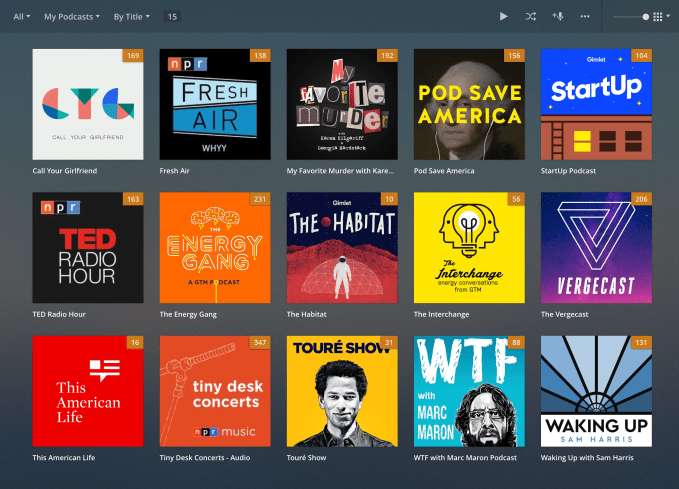
At CES in January, TechCrunch broke the news that media software maker Plex was planning to expand its service with the addition of new media content, starting with podcasts. Today, it’s making good on that promise by launching support for podcasts into beta, along with a whole new look and more customization options for its Plex mobile apps.

While Plex got its start as a software application for organizing people’s home media collections, it’s been expanding over the past couple of years to add new features in support of cord cutters who want to watch TV via their antenna, and record those shows. It also acquired the streaming news startup Watchup in order to add a dedicated news hub within its app.

Earlier this year, the company spoke of its ambitions to continue adding more types of content to its media center software, including audio and video podcasts, followed by digital, web-first and other longer-form creator content. (It had originally expected to add podcasts in Q1 2018, so this nearly-June launch is a bit of a delay.)

The larger goal, on Plex’s part, is to organize all your media content in one place – from live and recorded TV to your personal media collections of music, photos, and videos, and your news and information – including, now, your favorite podcasts.

The feature, live today in beta, is available on the Plex web platform, Roku, and iOS and Android, with other device support coming soon.

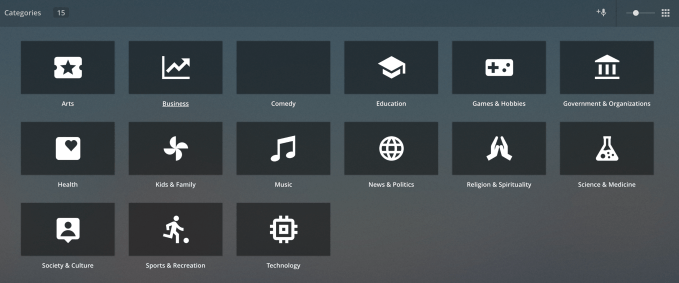
You can browse and search across Plex’s podcast library, filter podcasts by categories, or click into a title to see the details, episode lists, and related podcasts. To follow that podcast, you click the “Add to My Podcasts” button. This will add the podcast to your “On Deck” dashboard, as well.

If the podcast you like isn’t in the Plex catalog, you can add it by entering the feed URL, and Plex will treat it as if it is – it will retrieve all its metadata, related podcasts, and make it searchable. (That’s useful because Plex’s catalog isn’t as robust as others at launch.)

The feature also includes the standard media controls you’d expect, like forward and back and support for variable speed playback, as well as a “mark as played” option, all available through Plex’s upgraded media player. That option can help you transition to Plex’s podcast platform from another app, as you won’t have to lose your place, in terms of what you’ve listened to, and what you’ve not. And it lets you continually mark off any episodes you may have caught elsewhere, or just otherwise want to skip.

Your listening progress is also synced across Plex’s suite of apps.

The feature wasn’t perfect in brief testing, but it was in a pre-launch state, and today it’s only arriving in beta – so it’s too soon to speak to how well it performs as a publicly-facing product.

In a few weeks, Plex will roll out a handful of other features for podcasts, including smart downloading with granular controls for managing the episodes you want to keep on a per show basis (e.g. keep the last three); additional metadata for richer show pages and better discovery options; and podcasts import and export (OPML) so you can move your current subscriptions more easily into Plex.

Along with the launch of podcasts, Plex is updating its mobile apps, too, to offer better customization options.

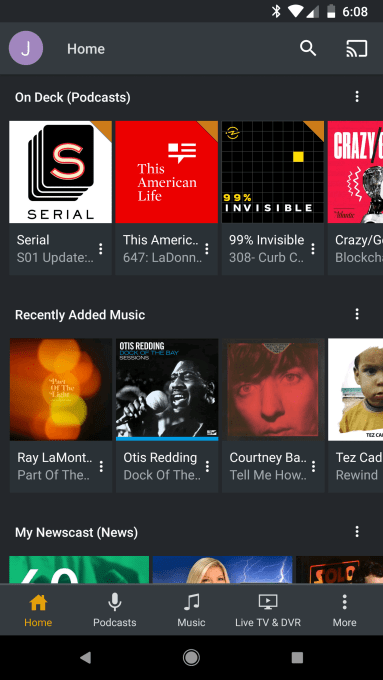
Now, if you want to listen to your podcasts and news while you’re on the go, on mobile, you can configure the app to show that media on your home screen. Or, if you use the app more for casting your videos to your living room TV, you could bring those favorite shows to the front of the experience instead. And so on.

On this new, customizable home screen you can re-order you content, remove any of its sections (like “Recently Added” or “On Deck,”), or add new ones from elsewhere in the app, including across servers (like Plex Cloud or your local server such as your home PC.)

Plex has also added tabs at the bottom of the screen for switching between your media type (e.g. movies, TV, podcasts, etc.), which are fully customizable, too. You can even customize the default source for each media type.

[gallery ids="1647814,1647815,1647813,1647812,1647811,1647806,1647805,1647803,1647802,1647799,1647795"]

The addition of podcasts to this more personalized media experience makes sense not only because of how popular podcasts have become, but also because many are tied to the shows you watch – they’re creator commentaries, roundtable discussions, fan chats, critic reviews, and more. It’s easy to imagine, then, moving from watching a show on the TV then heading out and launching the Plex app to listen to the podcast discussing the last episode.

That’s the vision Plex has, at least. However, even with these additions, Plex’s software overall still caters more to the DIY crowd – those who want set up their own antenna, rather than pay for an online TV service like YouTube TV or Sling. And it hasn’t yet solved the problem of media that’s all over the place – favorite shows and movies are strewn across services like Netflix, Hulu, HBO, and Amazon, and it’s hard to know where the things you want to watch reside. Those are still challenges Plex could attack in the future, by becoming a hub that jumps you into streaming catalogs, too.

It’s unclear how well Plex’s expansions have been working to attract new users and paying subscribers.

The company doesn’t break out the latter figure. and it still claims today the same 15 million registered users it had at the beginning of the year. Becoming a podcast player could help bump that number up, though, and introduce more people to Plex’s software, as a result.

Podcasts are in beta on web, mobile and Roku, and the mobile apps are rolling out starting today.

Tuesday, 29 May 2018

GIF lord Imgur caves to video to hasten profitability

Imgur is the internet’s best time sink, where 250 million monthly users silently consume an endless community-curated collection of absurd GIFs, inspiring tales, pop science explainers, and giant meme dumps. But what it’s never had is video. That was a differentiator that made it ideal for quiet browsing in class, on public transit, or in bed. Since none of the content required audio, you never had to worry about grabbing your headphones or disturbing those around you.

But the lack of video was also holding Imgur back. Sometimes you need to hear a crazy cat meow, or a baby giggling, or a crappy robot explode. So users would have to hunt down the “sauce” aka the GIF’s source video on another site. Oh, and advertisers love video and will pay a boatload more for it than a silent GIF or static image.

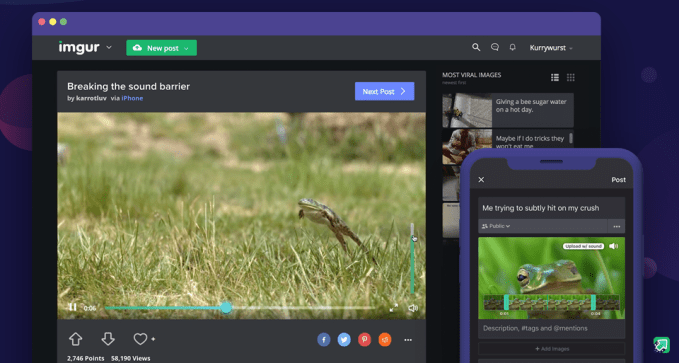
And so, Imgur is evolving with the launch of video. You can check them out, including this ream of popular GIFs reunited with their soundtracks, on the Imgur Unmuted channel.

The shift comes at a pivotal moment for the company. Launched in 2009, founder Alan Schaaf bootstrapped the startup to 130 million monthly visitors over the course of five years before finally taking a $40 million Series A from Andreessen Horowitz in 2014. Two years later it augmented its flimsy banner ads with full-screen promoted posts while trying not to damage the irreverent nature of the app.

Imgur’s Chief Operating Officer Roy Seghal, its Sheryl Sandberg, tells me that as of recently “we were cash flow positive” before revealing “We expect to be profitable this year.”

Video could push Imgur to that milestone. The more organic video posts from users, the easier it will be for Imgur to slide in lucrative video ads. Facebook printed money with the same strategy, rolling out auto-play video in 2014 to pave the way for video ads that command high prices from businesses. Imgur recently began allowing video ads, but they stuck out, seeming to violate the app’s code of silence. Now Imgur is training its users to tolerate or even embrace audio and video.

Next Comes Video Editing

Starting today, everyone can watch videos on Imgur, while iOS users can post video, with that opening to more people soon. Wisely, sound is off by default so you won’t get accidentally blasted, and technically you could just pretend they’re GIFs if you don’t click the audio button in the bottom right. They’re also limited to 30 seconds, so you won’t have lengthy YouTube reposts or as many copyright concerns, and they can be trimmed in the uploader.

“We’ve been making the transformation from an image community to a community-powered entertainment platform” says Seghal. Video could keep Imgur’s legion of users growing, and make sure they can experience today’s hottest content in whatever format it’s made for.

“We realized there was a vector of content we were not supporting that we thought our users would want” Seghal notes. The launch comes following the addition of much-requested Favorites folders and chat, and the Snapchat Stories-esque Snacks GIFs that no one asked for.

But video will bring a new sense of FOMO to those watching discretely. They’ll either have to swipe past the videos or miss the aural dimension. That could splinter Imgurians, who are otherwise united by a homescreen that shows identical top-rated content to everyone, unlike the fractured and personalized landing pages of most social networks. Some of Imgur’s funniest content relies on inside jokes powered by everyone having the right prerequisite knowledge from seeing the same things.

“They are definitely surprised” says Seghal, but he claims “the reaction has been very positive.” That’s not exactly clear from reading the Imgur Most Viral homepage, which just got a desktop redesign with bigger previews and easy access to popular tags you can explore. GIFs and still images still dominate and I’ve hardly seen any videos.

That could change as Imgur plans on equipping users with new editing tools to help them turn generic clips into weird and wacky stuff people love to upvote. Imgur’s existing Video-To-GIF creation tool has been a hit. Hopefully future editing tools will let people add custom subtitles, stickers, interjected titling screens, and more. Those will be crucial to keep video from making Imgur generic.

Alan Schaaf, founder of Imgur, and his sister/community director Sarah Schaaf, speaking at TechCrunch Disrupt

The pivot to video may be inevitable for all online content. Combined with every app from Instagram to Netflix to Airbnb adopting Snapchat’s Stories, there’s an unsettling convergence going on. Video may be the most vivid and emotive medium. Yet we’ll lose something if there’s a social network singularity where they all have the same features.

Imgur is looking to become a business that’s palatable to a mass audience with video. But it must take care not to forfeit esoteric absurdity that’s made it a vacation from the overwhelming news and envy spiraling of other feeds.

Apple releases iOS 11.4 with support for Messages in iCloud, AirPlay 2 and more

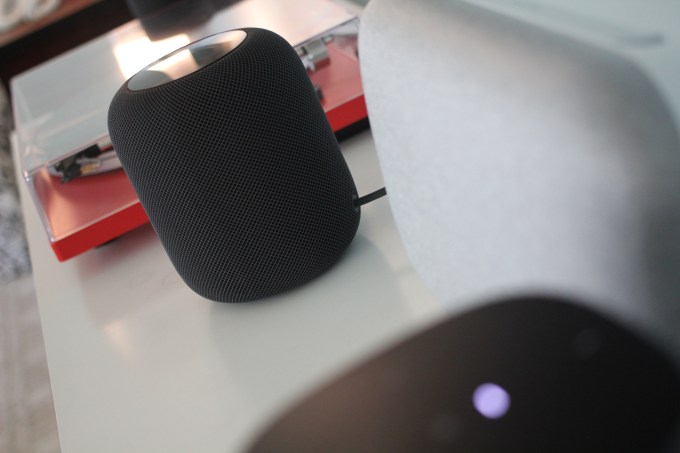
Apple this afternoon will officially release the latest version of its iOS software for your iPhone and iPad, iOS 11.4, which at last adds support for Messages in iCloud, along with other new features, including most notably, AirPlay 2 and an update that allows two HomePod speakers to work together as a stereo pair.

Messages in iCloud was first announced a year ago at WWDC 2017 as a way of keeping conversations up-to-date across all your Apple devices, including iPhone, iPad, Apple Watch and Mac. Its introduction means you’ll now be able to access your entire Messages history when you set up a new Apple device, and, when you delete a message from one device, that change syncs to all your devices.

In addition to the benefit of being able to access your entire conversation history, Messages in iCloud will be especially helpful to those who tend to save their all their conversations, but have a device without a lot of storage.

Typically, this has led to those conversations taking up a sizable amount of space – sometimes even gigabytes of storage, thanks to all the photos and attachments that are shared across iMessage these days. With Messages in iCloud, however, everything – including attachments – are stored in iCloud, which frees up local storage space for other things – like music downloads, videos, podcasts, books and apps, for example.

The messages are also end-to-end encrypted for security purposes. They’re protected with a key derived from information unique to the device, combined with the device passcode – which only the device owner should know. That means no one else could access or read the data.

The Messages in iCloud feature had first appeared in early betas of iOS 11 last summer, but was later pulled before the iOS public release. It later popped up again in the iOS 11.3 beta, but it was unclear when Apple would launch it, given that it had been left out of earlier iOS releases, despite all the beta testing.

Today, the feature is rolling out to all users, via iOS 11.4.

Also new in iOS 11.4 are features focused on media and entertainment, including the launch of AirPlay 2 and support stereo pair for HomePod.

AirPlay 2 allows you to stream your music or podcasts in your home to different devices, all in-sync. You can play music in any room from any room, move music from one room to another, or play the same song everywhere using an iOS device, HomePod, Apple TV, or by asking Siri. For example, you could say, “Hey Siri, play jazz in the kitchen,” while continuing to have different music played in another room. You can also adjust the volume across all devices (“Hey Siri, turn the volume up everyone”), or play or stop music across devices. 

A number of speaker manufacturers are already committing to support AirPlay 2, including Bang & Olufsen, Bluesound, Bose, Bowers & Wilkins, Denon, Libratone, Marantz, Marshall, Naim, Pioneer and Sonos.

The previously announced support for HomePod stereo pairs, meanwhile, lets you add a second HomePod to a room and create a stereo pair which play left and right channel content separately. The HomePod devices will automatically detect and balance with each other, and detect their place in the room in order to offer a better sound.

Apple has been positioning its speaker to better compete with more high-end audio systems, like Sonos or Bose. Stereo pair support will allow it to better compete on that front, but device sales could be held back by those who prefer Amazon’s Alexa assistant, which ships on the Sonos One, to Apple’s Siri.

Calendar support is also arriving for HomePod with iOS 11.4, along with the usual bug fixes and performance tweaks.

You can check for the iOS update from the Settings app, under “General –> Software Update.” HomePod owners can update from the Home app. The update is expected to start rolling out at 10 AM PT.

ZenScreen could help you achieve a ‘balanced digital diet’

Skyfire co-founder Nitin Bhandari is working on a new approach to cutting our addiction to social media and reducing screen time with a startup called ZenScreen.

The startup has raised $700,000 in funding from Opera (now Otello) and assorted angel investors. It launched iOS and Android apps last month, as well as a Chrome browser extension.

Bhandari, who also served as senior vice president of consumer apps at Opera after the acquisition of Skyfire, said that during his work on mobile browsers and apps, he started to worry about whether creating more engaging — even addictive — apps was a worthwhile goal: “The cognitive dissonance was really eating at me and my team.”

Existing apps lock you out of your browser or smartphone for limited periods of time — for example, I use Forest to cut down on distractions when I need to focus on writing. But Bhandari said the “don’t even touch your phone” approach is “just not practical” for many people.

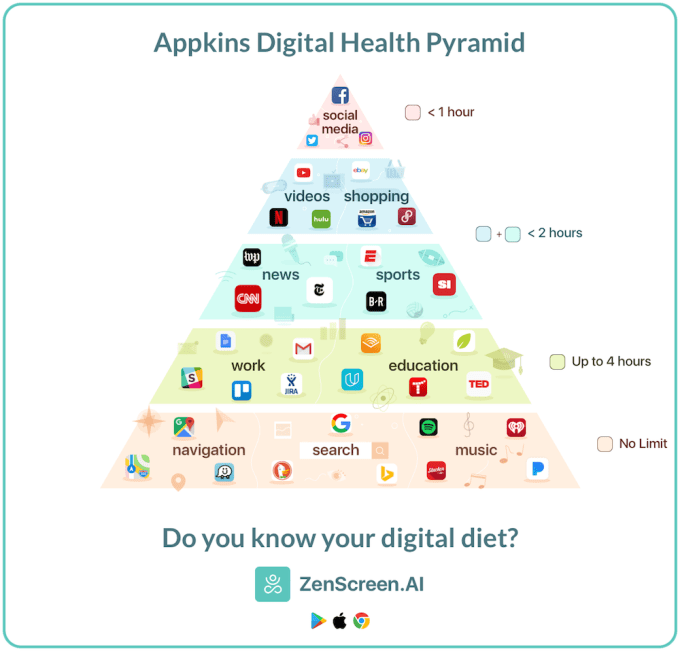
So ZenScreen includes a number of different features that are designed to create what Bhandari said is “almost like a balanced digital diet.” (In fact, ZenScreen created an “AppKins Digital Health Pyramid” showing which apps you can use as much as you want, and others that should  be limited.) Adults can use it to control their own app usage, as well as that of their kids.

Digital Health Pyramid

For example, instead of trying to keep you off your phone for, say, an hour each morning, ZenScreen offers something called Smart Mornings, where you have 10 minutes to access social apps, followed by 20 minutes where you can only open work apps and utilities. Similarly, you can set limits on how much time you spend on social/entertainment apps during the day and restrict social media again when it’s close to bedtime.

To do this, Bhandari said ZenScreen had to solve “a really hard problem to figure out which app is being used and how long it’s in the foreground.” The company uses VPN technology to monitor your app usage, though Bhandari said, “We have a very unique VPN where all of the technology runs right on your device and sensitive data never comes to our servers.”

ZenScreen offers access to personal app usage analytics and its Quiet Time feature for free, then charges $4.99 per month for everything else.

“I actually compare our pricing to a gym membership — that’s kind of what we’re doing for your brain,” Bahndari said. “When you compare it to $80 a month, or $100 a month for the gym, $4.99 seems like such a no brainer if this topic is important to you.”

Friday, 25 May 2018

Mobility startups: Apply to exhibit for free as a TC Top Pick at Disrupt SF ‘18

Mobility is one of the most rapidly advancing technologies going, and we’re searching for the rising stars of early-stage mobility startups to apply as a TC Top Pick for Disrupt San Francisco 2018 on September 5-7 at Moscone Center West. It’s a competitive application process, but if TechCrunch editors designate your company as a Top Pick, you get to exhibit for free in Startup Alley — the show floor and heartbeat of every Disrupt event. Besides, who doesn’t love free?

Mobile tech is on the cusp of a revolution, and we’re interested in startups focused on everything it entails — autonomous vehicles, sensors, drones, security — or something else altogether. Flying cars, anyone? Exhibiting in Startup Alley will expose your startup to more than 10,000 attendees, including potential investors, customers, partners and more than 400 media outlets.

Here’s how the TC Top Pick process works. First things first: apply now. Our expert team of editors will review each application and choose only five mobility startups as TC Top Picks. They also will select five startups for each of the following tech categories: AI, AR/VR, Blockchain, Biotech, Fintech, Gaming, Healthtech, Privacy/Security, Space, Retail or Robotics. A total 60 companies will exhibit in Startup Alley as a TC Top Pick.

If your mobility startup makes the cut, you receive a free Startup Alley Exhibitor Package, which includes a one-day exhibit space in Startup Alley, three founder passes good for all three days of the show, use of CrunchMatch — our investor-to-startup matching platform — and access to the event press list.

In addition to all the other potential media opportunities, TC Top Picks also get a three-minute interview on the Showcase Stage with a writer — and we’ll share the heck out of that video across our social media platforms. That’s promotional gold right there, folks.

And who knows? As a Startup Alley exhibitor, your company might even get selected as the Startup Battlefield Wildcard — if they do, you get to compete in Startup Battlefield for a shot at the $100,000 prize.

Disrupt San Francisco 2018 takes place on September 5-7. Don’t miss your opportunity to exhibit in Startup Alley for free. The TC Top Pick deadline is June 29, and we have special offers for early applicants. Does your startup have what it takes to be one of the five mobility TC Top Picks? Apply today to find out.

Google’s Duo and Cisco’s Webex Teams among the VoIP apps pulled from the China App Store

Earlier this week, it came to light that Apple had removed a number of VoIP-based calling apps from the App Store, at the request of the Chinese government. The apps had been using CallKit, Apple’s new developer toolset that provides the calling interface for VoIP apps, freeing up developers to handle the backend communications. China’s government asked developers, by way of Apple, to remove CallKit from their apps sold on the China App Store, or they can remove their apps entirely.

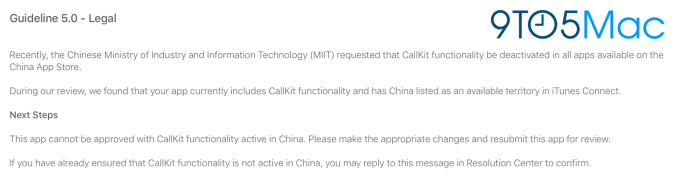
Notices Apple sent out to the developers were first spotted by 9to5Mac, who shared a snippet from of one of the emails.

The email states that the Chinese Ministry of Industry and Information Technology (MIIT) “requested that CallKit be deactivated in app apps available on the China App Store,” and informed the developer they would need to comply with this regulation in order to have their app approved.

The regulation only impacts apps distributed in the China App Store.

We understand that the apps can still use CallKit and be sold in other markets outside the region.

Apple is not publicly commenting on the matter.

The pushback against CallKit is another means of discouraging people from developing or using VoIP services in China, without having to go so far as to ban the apps directly. It wouldn’t be the first time China has cracked down in this area. In November, Microsoft’s Skype was also pulled from the Apple and Android app stores.

The government also last year ordered VPN apps, which help users route around the Great Firewall, to be pulled from app stores – another order with which Apple complied.

Other social media apps, like WhatsApp and Facebook, are also disrupted at times, and newspapers’ apps like those from The NYT and WSJ are blocked, too.

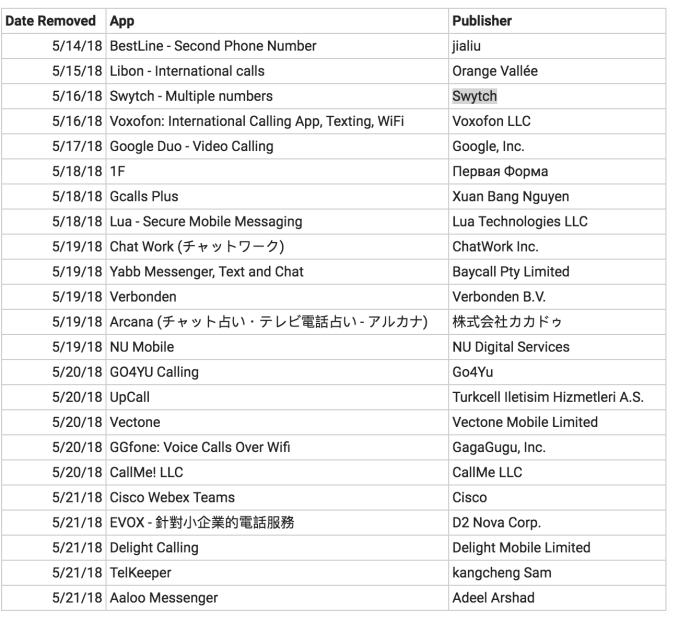
According to data pulled by app store intelligence firm Sensor Tower, two dozen apps with CallKit had been removed during the week prior to the news reports.

That list, along with the date removed and publisher name, is below:

Sensor Tower notes it’s possible that there are other apps removed from additional stores, but doesn’t have that data.

In addition, this list only includes those apps that have been downloaded enough times to rank in the top 1,500 of an app category at some point – beyond that Sensor Tower wouldn’t pick it up. But an app that wasn’t ranked would have had so few downloads that the impact of its removal would be minimal.

Nevertheless, you can see list includes a few well-known names, including Cisco’s Webex Teams and Google’s Duo video calling app, among those from other operators and VoIP calling providers.

The full text of Apple’s email is below:

From Apple
5. Legal: Preamble
Guideline 5.0 – Legal

Recently, the Chinese Ministry of Industry and Information Technology (MIIT) requested that CallKit functionality be deactivated in all apps available on the China App Store. During our review, we found that your app currently includes CallKit functionality and has China listed as an available territory in iTunes Connect.

Next Steps

This app cannot be approved with CallKit functionality active in China. Please make the appropriate changes and resubmit this app for review. If you have already ensured that CallKit functionality is not active in China, you may reply to this message in Resolution Center to confirm. Voice over Internet Protocol (VoIP) call functionality continues to be allowed but can no longer take advantage of CallKit’s intuitive look and feel. CallKit can continue to be used in apps outside of China.

Thursday, 24 May 2018

Some low-cost Android phones shipped with malware built in

Avast has found that many low-cost, non-Google-certifed Android phones shipped with a strain of malware built in that could send users to download apps they didn’t intend to access. The malware, called called Cosiloon, overlays advertisements over the operating system in order to promote apps or even trick users into downloading apps. Devices effected shipped from ZTE, Archos and myPhone.

The app consists of a dropper and a payload. “The dropper is a small application with no obfuscation, located on the /system partition of affected devices. The app is completely passive, only visible to the user in the list of system applications under ‘settings.’ We have seen the dropper with two different names, ‘CrashService’ and ‘ImeMess,'” wrote Avast. The dropper then connects with a website to grab the payloads that the hackers wish to install on the phone. “The XML manifest contains information about what to download, which services to start and contains a whitelist programmed to potentially exclude specific countries and devices from infection. However, we’ve never seen the country whitelist used, and just a few devices were whitelisted in early versions. Currently, no countries or devices are whitelisted. The entire Cosiloon URL is hardcoded in the APK.”

The dropper is part of the system’s firmware and is not easily removed.

To summarize:

The dropper can install application packages defined by the manifest downloaded via an unencrypted HTTP connection without the user’s consent or knowledge.
The dropper is preinstalled somewhere in the supply chain, by the manufacturer, OEM or carrier.
The user cannot remove the dropper, because it is a system application, part of the device’s firmware.

Avast can detect and remove the payloads and they recommend following these instructions to disable the dropper. If the dropper spots antivirus software on your phone it will actually stop notifications but it will still recommend downloads as you browse in your default browser, a gateway to grabbing more (and worse) malware. Engadget notes that this vector is similar to the Lenovo “Superfish” exploit that shipped thousands of computers with malware built in.

Dog-sitting startup Rover just raised $155M

Rover, a dog-walking and dog-boarding service that merged with DogVacay around this time last year, is now the second of such startups this year to raise a massive new round of funding with its announcement of a $155 million financing round.

While competitor Wag has become a juggernaut, there seems room for both room for a second player and the potential to outmaneuver Wag even with its massive influx of capital. Both DogVacay and Rover had a very similar model and eventually merged in an all-stock deal, creating a more substantial competitor for Wag. The round consisted of $125 million in equity financing led by funds and accounts advised by T. Rowe Price Associates, with a $30 million credit facility with Silicon Valley Bank. The Wall Street Journal is reporting that the round values Rover at $970 million.

Wag earlier this year picked up $300 million in a massive funding round led by SoftBank. That was, of course, SoftBank — which is investing massive piles of capital into startups and pretty much altering the calculus of venture capital in the process. But it also signaled a huge interest in various dog-care services, including apparently Rover, as a potential business opportunity for the millions of dog owners in the world. If you’ll walk anywhere in San Francisco, you’re destined to run into a very large number of very good dogs, and it makes enough sense that there should be an opportunity to capitalize on dog-ownership as a whole.

Rover connects dog owners with various users that will walk, board, or generally take care of dogs — a critical service for anyone who might be traveling, or just work in a non-dog friendly office. Users just book a dog walker or sitter through the app, which connects them with area sitters. It’s an area where Wag has faced a lot of criticism following a major Bloomberg report regarding poor service (and losing dogs). There are, of course, many challenges for any service that offloads some kind of daily need to a third party starting in a similar fashion to Uber.

Rover, interestingly, notes on its website that it “accepts less than 20% of potential sitters,” perhaps a dig at the criticism for Wag or the space in general and as an attempt to soothe concerns from potential users. Rover says it has more than 200,000 sitters throughout North America. The company previously raised $156 million, and previous investors include A-Grade Investments, Foundry Group, Madrona Venture Group, Menlo Ventures, OMERS Ventures, Petco, and StepStone Group.

Wednesday, 23 May 2018

Samsung adds ‘The Incredibles’ to its AR Emojis

Samsung’s AR Emojis were met with a…lukewarm reception when they launched alongside the Galaxy S9. The augmented reality avatars were regarded as a me-too response to Apple’s Animojis — and more to the point, were downright creepy.

But at launch, the company brought one key element to the offering that Apple hasn’t: a content partnership. And not just any content partnership, mind. A Disney content partnership. So far, it’s rolled out the iconic likes of Mickey, Minnie and Donald, and now, just in time for the latest Pixar sequel, it’s offering up the cast of The Incredibles 2.

Starting today, Galaxy S9 and S9+ owners can download  Mr. Incredible, Elastigirl, Violet, Dash, Jack-Jack and new character Frozone, for all of their AR Emoji-related needs. So users can send a birthday greeting, reach out to a loved one or break up with an ex as their favorite super baby.

The new content pack is available directly through the camera software’s built-in AR Emoji mode. The tech uses in excess of 100 facial features to map the user’s movements.

Apple offers a $50 credit for some out-of-warranty iPhone battery purchases

If you bought a battery replacement for an out-of-warranty iPhone last year, you may be eligible for a $50 credit from Apple. The company issued a new support page post this week, announcing the rebate policy, which applies to purchases made at authorized locations.

The move is part of on-going restitution in the wake of an admission that the company was throttling processing speeds on older model phones, in order to save on battery life. Late last year, Apple apologized for not informing users about the issue, promising to be more transparent in the future.

Soon after, the company began offering $29 battery replacements — a $50 discount on out-of-warranty battery replacements. This credit covers those who purchased a battery out-of-warranty any point in 2017, leading up to that new offer.

The company has promised to send an email to all eligible users with instructions on how to get the credit transferred to their account between now and July 27. Those who don’t get a notification, but still believe themselves to be eligible, can contact Apple directly between now and the end of the year.