Everything Apple

Thursday, 26 July 2018

IGTV carousel funnels Instagram feed traffic to buried videos

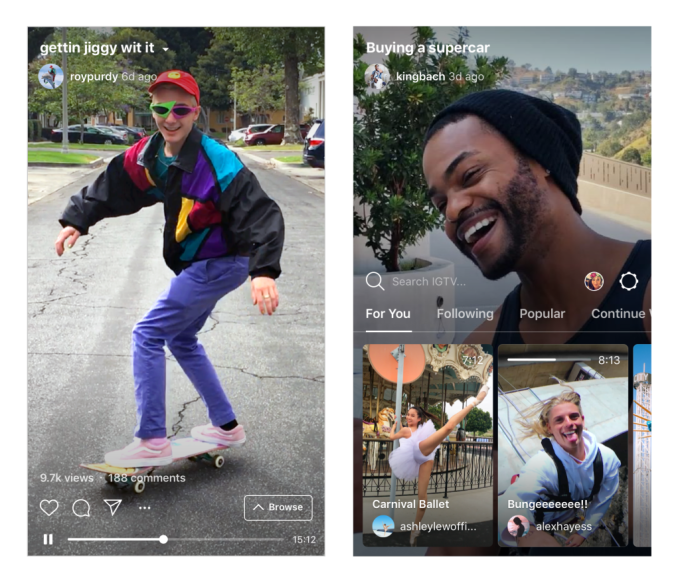
IGTV didn’t get the benefit of being splayed out atop Instagram like Stories did. Instead, the long-form video hub is a bit more distant, located in a standalone app as well as behind a static orange button on the main app’s homescreen. That means users can go right on tapping and scrolling through Instagram without coming across IGTV’s longer videos that range up to an hour.

IGTV has only been out a month and Instagram’s feed has been around for 8 years so it makes sense to try to push views from the app’s core feature to this new one. That’s why Instagram is experimenting with a way to show off a carousel of IGTV videos in its main app’s feed. Spotted by app researcher Jane Manchun Wong, we asked Instagram about it. A spokesperson confirmed it was testing the carousel, and provided this statement: “We’re always testing new and different ways to surface interesting content for people on Instagram.”
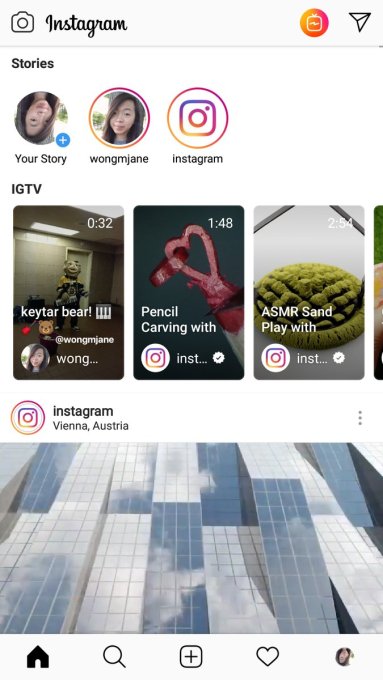
The IGTV carousel appears below the Stories tray, pushing down the traditional feed so less of the first photo or video immediately appears on the screen. It shows a preview tile of the IGTV videos with overlaid titles and lengths, plus the creator’s name and profile pic. They look similar to Snapchat’s Discover page and the carousels of “Recent Stories” Instagram began running mid-feed last year.

By teasing IGTV’s actual content rather than just slapping a logo buton atop the screen, Instagram might get more users to check out the feature and standalone app. More views could in turn lure more content from creators. If they don’t see IGTV’s audience as significant, they won’t go to the trouble of shooting long-form vertical video for the platform or editing their landscape Instagram feed and YouTube videos for the format.
Given yesterday’s bloodbath of a Facebook earnings report, there’s more pressure than ever on Instagram to pull its weight. Facebook sunk to its slowest growth rate in history, losing users in Europe and going flat in North America. In fact, it revealed a new “family of apps audience” metric of 2.5 billion people using at least one of Facebook’s apps (Facebook, Instagram, WhatsApp, or Messenger) to distract from the bad news. That stat will let Facebook hide how younger users are abandoning it in favor of Instagram.

The big concern is that vertical videos and Stories are the future of content creation and consumption, but Facebook hasn’t figured out how to monetize these formats as well as its tried-and-true News Feed ads. Concerns about eyeballs shifting away from feeds faster than ad dollars contributed to Facebook’s 20 percent share price drop erasing $120 billion in market cap.

But Facebook’s saving grace, and the reason the stock might bounce back, is that it ruthlessly cloned Snapchat Stories for two years before it was obvious that it had to and now has 1.1 billion daily Stories users across its apps. If Facebook said Stories were the future but it was way behind, it could have been beaten down even worse by Wall Street.

Still, short-form Stories are best paired with short-form Stories ads. If it can make IGTV a hit, it could run longer o unskippable ads that earn it more. So you can expect to see more and more of IGTV in the Instagram feed.

Snapchat “Storytellers” program pairs creators with advertisers

Snapchat hopes to boost ad spend by connecting businesses with its top independent creators, but it won’t take a cut of deals it helps arrange. Today Snap Inc launches its “Snapchat Storytellers” pilot program that will introduce brands to five of the app’s most popular content makers including Mplatco, Cyrene Q, and Shonduras. They’ll star in ads for Stories and Discover or provide creative direction to brands with their expertise gleaned from gathering audiences of millions over the past few years in exchange for cash. Top creators can often earn tens of thousands of dollars or more for deals with brands.

The program is late but a smart move for Snapchat, since it needs to educate businesses about how to make great Stories ads. These often require stylish vertical video that’s a big creative jump from the tiny photo, link, and text ads many are accustomed to, or even the pithy landscape videos they’ve learned to make for YouTube or Facebook. If creators can help brands make great looking ads that perform well, those businesses will be more likely to spend a lot more on Snapchat.

That’s critical for the public company which lost $385 million last quarter and missed its revenue estimate by $14 million when it brought in $230 million. With Facebook’s Snapchat Stories clones from Instagram and WhatsApp depressing Snap’s user growth rate to a measly 2.9 percent (its lowest rate ever), the company will have to figure out how squeeze more dollars out of each user it already has.

Meanwhile, if Snap extends the program to more creators, it could be a good way to help them monetize and stay loyal to the platform. YouTube has long offered ad revenue shares and Facebook’s ad breaks let creators insert commercials into their videos for a cut of money. Both are experimenting with subscription patronage and tipping options to help creators earn money. Facebook recently launched its Brand Collabs manager that offers an entire search engine of creators that brands can sort by audience demographics.

But Snapchat still doesn’t have any of these options, and its Storytellers program looks half-hearted in comparison. As the social media influencer space matures, many creators are sick of giving away their content for free, and will bring their best work to whatever network helps get them paid.

Still, Snap will take a relatively hands-off approach in terms of how deals between brands and creators are struck. It’s not going to take a cut, nor will creators get locked into exclusivity contracts with Snap or the businesses. Basically, Snap is adding the five creators that include Geeohsnap and Georgio Copter to its Creative Partners list alongside ad agencies and creative studios. If advertisers express interest in a creator, Snap will make an introduction then leave them to work out the deal.

It’s dumbfounding that Snapchat waited this long to launch this program, and it didn’t even come up with it. It was the weirdo “gummy money” former Vine star Shonduras that suggested Snapchat build the program during its first Creators Summit back in May. That shows how out of touch with the creator community Snap was until now. If it can’t grow its user count quickly, it should be doing everything it can to keep creators and advertisers from straying to Facebook’s Stories platforms with a lot more users.

Samsung teases Note 9’s extended battery life in new video spot

Based on the many, many Galaxy Note 9 leaks we’ve seen in the past few weeks and months, it seems like a pretty safe bet that the upcoming phablet won’t look all that different from its predecessors. The phablet does, however, appear to have a lot going under the hood.

The most recent piece of news hinted at a massive 4,000 mAh battery — marking a 700 mAh jump over its predecessor. That’s some pretty rarified on-board battery air right there. The first in a series of quick video spots for the handset does appear to confirm an increased capacity, without going into any specifics. And, naturally, it takes Apple to task in the process. That’s just Samsung’s M.O. these days. 

A sizable jump in battery is notable for one key reason, of course. Samsung’s been pretty cautious on that front ever since all of those Note 7s started exploding a few years back. The company apologized profusely, before instituting a bunch of new safety mechanisms in the process. Since then, it hasn’t…played with fire, so to speak.

From the looks of it, however, the company’s August 9 event could change all of that.

LG Mobile’s losses continue but now sales are falling too

Korean electronics giant LG is soaring to new heights, but its mobile division continues to lag well behind the rest of the company and the signs aren’t promising.

LG’s latest financials released today recorded another quarter of success with operating profit jumping 16 percent year-on-year to hit KRW 771 billion ($715.1 million) as overall sales rose 3.2 percent across the group. LG said its sales and profit for the first half of 2018 are at all-time highs but — and you knew a but was coming… — its smartphone division remains a significant loss-maker.

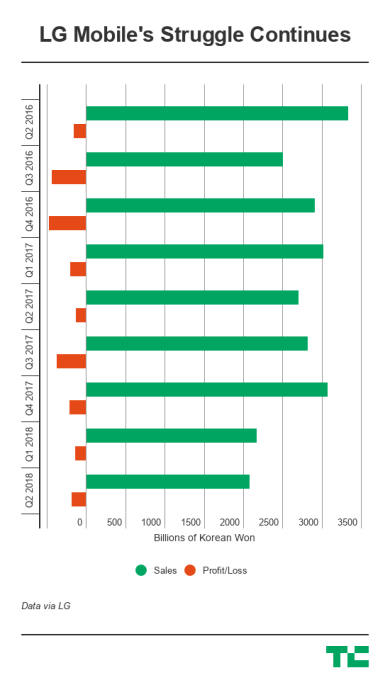
The company’s mobile and communications division — which houses LG Mobile — posted yet another quarter in the red. Sales of KRW 2.07 trillion ($1.92 billion) represented an annual drop of 23 percent, while the division carded an operating loss of KRW 185.4 billion, or $171.95 million.

That’s compared to a quarterly profit of KRW 407 billion ($377.48 million) for LG’s home entertainment business and a KRW 457.2 billion ($424.04 million) profit for its home appliance unit, which are LG’s two stand-out business units.

There’s nothing new herelosses are commonplace for LG Mobile.

It hasn’t been break-even or profitable since 2014. Those losses have been cut by some degree since the company shook up the division with new leadership in November 2017, but there’s plenty to worry about with sales dipping noticeably over the past two quarters of business.

This time around in Q2, LG put its mobile losses down to “the slowing growth of the global smartphone market and a decline in mid- to low-end smartphone sales in Latin America.” While it claimed that the size of the operating loss was down to investments in sales and marketing ahead of the release of its next flagship devices.

There’s a hint a reorganization — perhaps even layoffs — as the company added that it would “seek to further improve its business structure” as it aims prepares to push its LG G7 ThinQ and LG V35 ThinQ devices worldwide and get ready for those new launches.

More changes are on their way, you’d imagine, as LG is surely looking for a way to stem the bleeding but also retain a mobile business has certainly been iconic despite its struggles in recent times. Perhaps the answer is a downsizing in a similar style to Sony in 2016. Back then, the Japanese firm was losing even more than LG is per quarter but it began to be more strategic with its new device launches and target sales markets. The end result of that strategy was an end to the big losses and a more sustainable mobile business.

Wednesday, 25 July 2018

Apple’s Search Ads expand to six more markets in Europe and Asia

In December, Apple introduced a new pay-per-install ad product called Search Ads Basic aimed at smaller developers, to complement the existing Search Ads product, which then became known as Search Ads Advanced. Today, the company is expanding Search Ads to more countries, including France, Germany, Italy, Japan, South Korea, and Spain, bringing the total number of countries where Search Ads is available to thirteen.

In addition to the U.S., Search Ads Advanced had already expanded to Australia, Canada, Mexico, New Zealand, Switzerland, and the U.K.

Developers in the newly supported countries will be able to create campaigns using Search Ads Advanced starting on July 25, 2018 at 4 PM PDT, with those campaigns appearing on the App Store starting August 1, 2018 at 4 PM PDT.

Meanwhile, Search Ads Basic will be available across all thirteen supported countries starting on August 22, 2018 at 10 AM PDT.

To encourage sign-ups, Apple is offering first-time advertisers a $100 USD credit to try out the product.

While the first version of Search Ads launched back in October 2016 in the U.S., the idea behind the newer “Basic” product was to offer developers a different – and simpler – means of reaching potential customers.

Search Ads was originally designed to allow developers to target users’ keyword searches, combined with other factors like location, gender or whether or not they had installed the app in the past. Developers would pay when users tapped on those targeted ads.

With the launch of Search Ads Basic, it’s easier to set up campaigns.

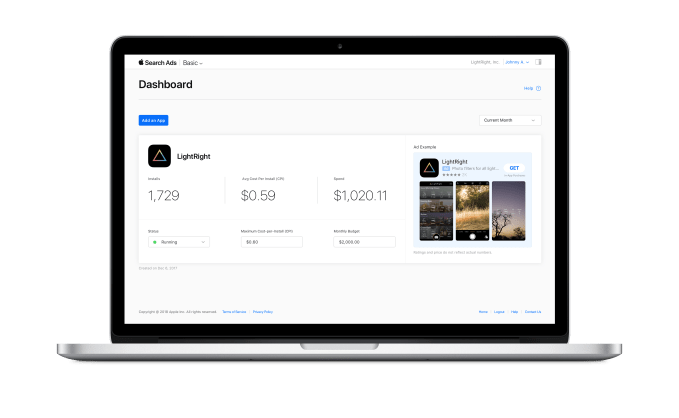
Developers only have to enter the app to be advertised, the campaign’s budget, and how much they want to pay per install. Apple helps by suggesting the max developers should pay using historical data. Then, developers only pay for actual installs, not taps.

Although the App Store was redesigned with the launch of iOS 11 to offer improved discoverability, search is still a key way people find out about apps.

Apple says that over 70 percent of App Store visitors use search to discover apps, in fact, and 65 percent of all downloads come directly from an App Store search.

The ads work well, too, as they have an over 50 percent conversion rate, on average, says Apple.

Apple’s advantage over the pay-per-install ads found elsewhere on the web isn’t only the ads’ placement – at the top of App Store searches, where they’re identified with a blue background and “Ad” icon – it also manages this without violating user privacy. That is, it doesn’t build specific profiles on individuals for ad targeting purposes, and it doesn’t share user data with developers. By its nature, this makes the system GDPR compliant.

In addition, Apple only places an ad when it’s relevant to a user’s search – developers can’t pay more to have their ad shown more often across less relevant searches, which offers a more level playing field.

Apple didn’t say when Search Ads would reach other countries, but with the new expansions it has some of the top markets now covered.


Facebook loses $120 billion in market cap after awful Q2 earnings

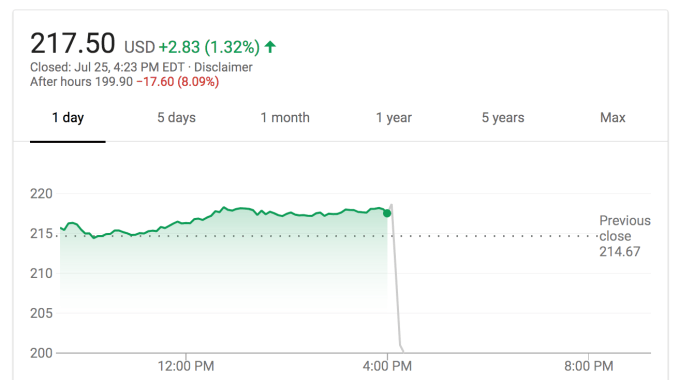
Facebook’s share price fell over 20 percent in after-hours trading today after the company announced its slowest-ever user growth rate and a scary warning that its revenue growth would rapidly decelerate. Before today’s brutal Q2 earnings, Facebook’s share price closed today at $217.50, but fell to around $172 after the earnings call. That’s a market cap drop of roughly $123 billion. In two hours, Facebook lost more value than most startups and even public companies are ever worth.

Here’s the full story on Facebook’s disastrous Q2 2018 earnings:

So why did Facebook’s share price sink like a stone? There are five big reasons:

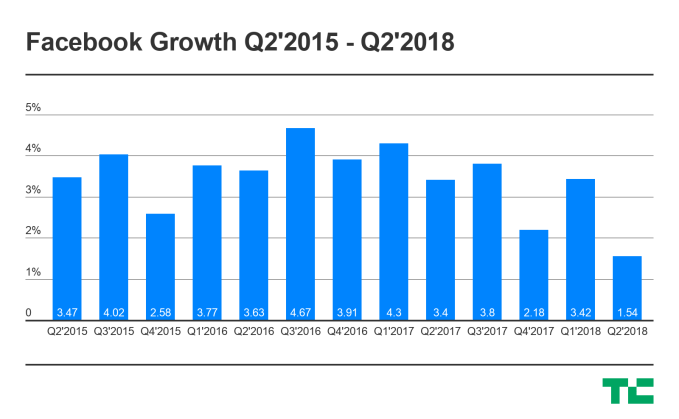
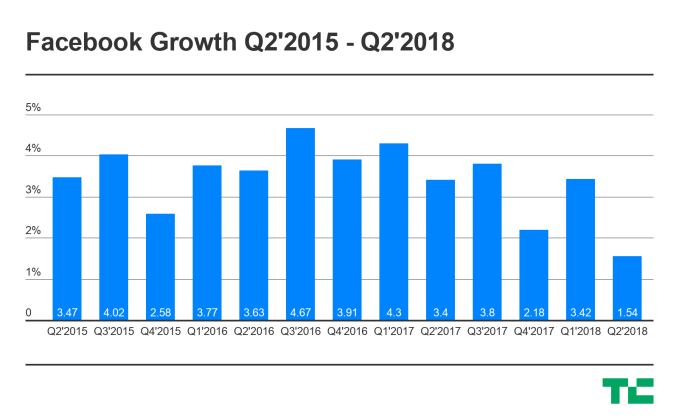
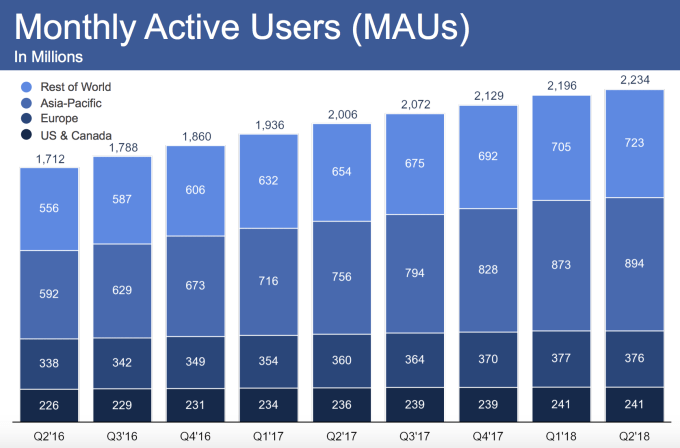
Slowest-Ever User Growth Rate – Facebook’s monthly user count grew just 1.54, compared to 3.14 last quarter. Daily active users grew even slower at 1.44 percent, compared to 3.42 percent last quarter. For reference, 2.18 percent was its previous slowest DAU growth rate back in Q4 2017. Suddenly hitting this wall could limit Facebook’s total user count over the long-run, and its revenue with it. Facebook tried to distract from these facts by announcing a new “family of apps audience” metric of 2.5 billion people using at least one of its apps, which will hide the shift of users from Facebook to Instagram and WhatsApp.

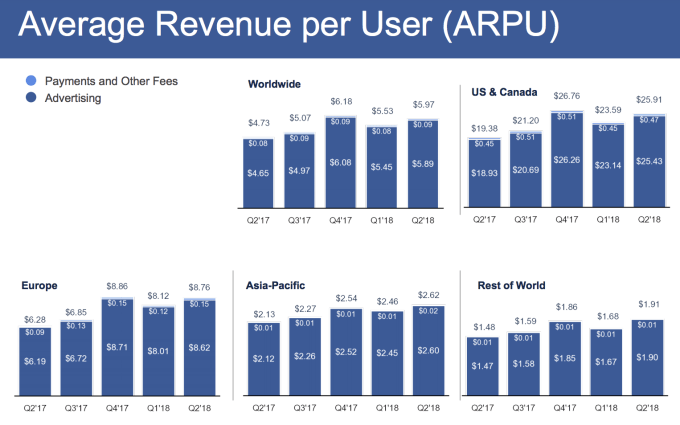
User Count Shrank In Europe, Flat In US & Canada – Facebook saw its first-ever decline in monthly user count in Europe, from 377 million to 376 million. It got stuck at 241 million in the US & Canada after similarly pausing at 239 million in Q4 2017. Those are Facebook’s two most lucrative markets, with it earning $25.91 per user in North America and $8.76 in Europe. If those markets stall, even swift growth in the Rest Of World region where it earns just $1.91 per user won’t save it.

Decelerating Revenue Growth – Facebook’s revenue grew a remarkable 42 percent year-over-year this quarter. But CFO David Wehner warned that metric would decelerate by high single-digit percentage per quarter over the coming quarters. Wehner said a combination of currency headwinds, new privacy controls, and new experiences like Stories will contribute to the deceleration. This news is what caused Facebook’s share price to drop from -7 percent to `-20 percent.

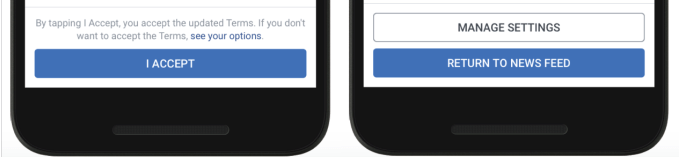
Privacy And Well-Being – Q2 saw the debut of Europe’s GDPR that forced Facebook to change its privacy policies and get users to agree to how it collects data about them. Wehner blamed GDPR for Facebook loss of users in Europe. That law and Facebook’s Cambridge Analytica scandal led the company to have to improve its privacy controls. These could make it tougher for Facebook to target people with ads or show their content to more people.

Meanwhile, Facebook has continued to adopt the “Time Well Spent” philosophy, removing click-bait news and crappy viral videos that lead to passive internet content consumption that studies say is unhealthy. Instead, Facebook is pushing features like Watch Party where users actively interact with each other. Those might not produce as much time on site and subsequent ad views, but CEO Mark Zuckerberg said the changes are “positive and we’re going to continue in this direction.”

The Shift To Stories – Facebook estimates that by in 2019, sharing via ephemeral vertical Stories slideshows will surpass sharing via feeds. The problem is that advertisers may be slower than users to make that shift. “Will this monetize at the same rate as News Feed? We honestly don’t know” COO Sheryl Sandberg said. Stories ads might be full-screen and more immersive, but they don’t show off links to online stores as well, nor are they as well optimized from decades of banner ad experience by the industry.

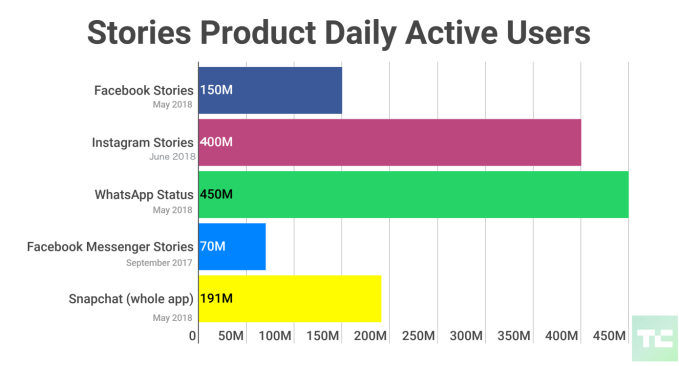
Luckily, even though Snapchat invented the Stories format, Facebook has far more people using it each day, with 150 million Stories users on Facebook, 70 million on Messenger, 400 million on Instagram, and 450 million on WhatsApp. If Facebook does manage to figure out Stories ads, it could dominate, but it could take years for its advertiser count and ad prices to rise to offset the shift away from feeds.

2.5 billion people use at least one of Facebook’s apps

Facebook today for the first time announced that in June, 2.5 billion people used at least one of its apps: Facebook, Instagram, WhatsApp, or Messenger. That’s a helpful number because it counts real people, rather than accounts, since people can have multiple accounts on a single app. 2.5 billion people compares to 2.23 billion monthly users on Facebook, 1 billion users on Instagram, 1.5 billion users on WhatsApp, and 1.3 billion users on Messenger.

Mark Zuckerberg announced the new stat on Facebook’s Q2 2018 earnings call following a tough report that saw its user growth slow to its lowest rate ever. Zuckerberg said the 2.5 billion count “Individual people rather than active accounts” which he says “excludes when people have multiple accounts on a single app. And it reflects that many people use more than one of our services.”

It seems as if Facebook announced the stat in hopes of deflecting attention from the fact that its user count shrank in Europe and was flat in the US & Canada, contributing to extraordinarily low monthly and daily user growth. That growth trouble in turn sent Facebook’s share price down over 9 percent in after-hours trading.

On the 2.5 billion stat, Facebook CFO David Wehner explained that “We believe this number better reflects the size of our community.” He also clarified that Facebook’s monthly active user count of 2.23 billion “does count multiple accounts for a single user, and that accounts for 10 percent of Facebook’s MAU” or 223 million.

We’ll have more details shortly

Facebook sees mixed Q2 earnings with slowest-ever growth, stock tanks

Facebook succumbed to the public backlash over its handling of fake news, privacy, and digital wellbeing to miss some of Wall Street’s estimates, showing mixed results in its Q2 2018 earnings. GDPR, Mark Zuckerberg’s testimony before congress, and more scandals appear to have contributed to Facebook’s weak user growth, with it reaching 2.23 billion monthly users, up 1.54 percent, much slower than Q1’s 3.14 percent around where its growth rate has hovered for years. Facebook earned $13.23 billion in revenue, missing Thomson Reuters consensus estimates of $13.36 billion, but beat with $1.74 EPS compared to an estimated $1.72 EPS.

Daily active users reached 1.47 billion, up an especially low 1.44 percent percent compared to Q1’s 3.42 percent. Facebook’s daily and monthly user counts were up 11 percent year-over-year, confirming that the momentum of its business is still overpowering its PR problems when you zoom out. And its DAU to MAU ratio held firm at 66 pecent, indicating that users are still visiting the site often. But the question for today’s earnings call will be whether time spent on the site has decreased significantly, dragging down revenue with it.

The stock market frowned heavily on the slow growth rates, pushing Facebook’s share price down over 7 percent in after-hours trading to around $200 per share. That’s despite it earning $5.106 billion in profit and revenue being up 42 percent year-over-year.

One trouble spot for Facebook was that it got stuck at 241 million monthly US & Canada users, the same count as last quarter. And in Europe, Facebook lost 1 million users, sinking to 376 million monthlies. That could be sign that GDPR requirements and the annoying terms of service changes it had to get users to agree to deterred some from browsing.

Facebook still managed to boost its average revenue per user in all markets, growing from $23.59 to $25.91 in the US & Canada, showing its targeting continues to improve and competition for ads is strong. But the fact that it’s stopped growing at home could way heavily on its share price. Facebook will have to continue to invent more ways to squeeze dollars out of its existing users.

The quarter saw Facebook clamp down on APIs for developers in hopes of preventing another Cambridge Analytica style disaster. Its CEO faced tough days of questioning from congress over the privacy problem, alleged bias against conservatives, and its failure to protect the 2016 presidential election. Facebook tried to redirect attention away from its problems during its F8 conference that saw it announce plans for a dating feature.

But all the problems may be taking a toll on user engagement, leading to the revenue miss. Weak daily and monthly user growth should be a big concern, and will put even more pressure on Instagram to prop up the corporation.

Android P’s final beta preview is live

Good news for people who like near-final previews of mobile operating systems. Android just dropped Beta 4 for Android P, marking the last preview milestone before the full version launches. That means the still unnamed OS is just around the corner — promised to arrive at some point later this summer.

As the all of the above implies, this build should be pretty close to final, including all of the systems you’ll see in the shipping version. The release is primarily focused on developers, looking to make sure their apps are up to date with Android P when it ships.

That includes a number of the new OS features, which will impact usage across apps, including multi-camera support, display cutout, enhanced notifications and ImageDecoder. More details on all of that can be found here.

Of course, the build is open to anyone who signs up for the Android Beta Program, so long as you also have access to a Pixel device to test it on — there’s a sign up form here. Those who have been testing out earlier builds should be receiving Beta 4 as an automatic update at some point in the near future.

No specific date has been given for the final build — just that it’s “coming soon.” Ditto for the name — though there’s no shortage of dessert foods starting with “P.” These days, I’m leaning toward Pop Rocks. But then, I’m kind of always leaning toward Pop Rocks. Hey, anyone know where a guy can get some Pop Rocks in 2018?

Anyway, more info here

Outvote hopes to flip elections by getting Democrats to text their friends

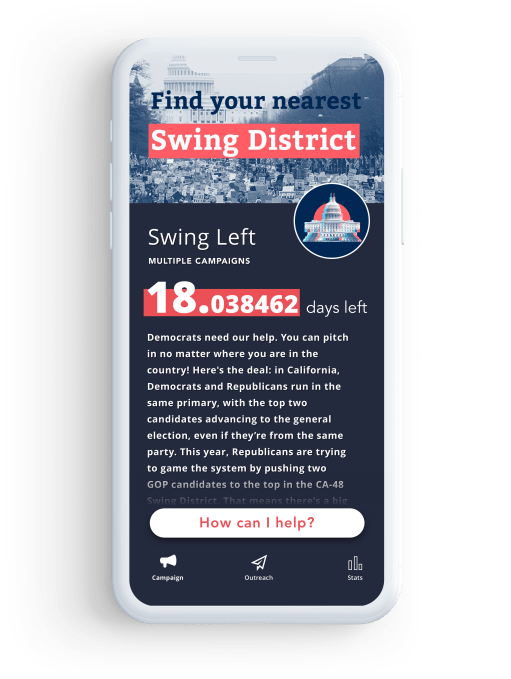
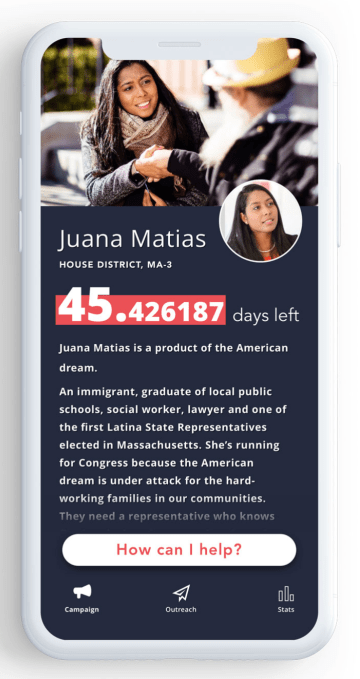
Outvote, a new Y Combinator-backed startup, wants to make grassroots-style campaigning easier and more personal, with the launch of an app that allows people to text their friends with reminders to vote. The idea is to take advantage of people’s willingness to use social sharing to communicate about political issues, while also leveraging the simplicity that comes with tweeting or posting to Facebook and turning that into an actionable reminder that can actually drive people to the polls during critical times.

The startup was founded by Naseem Makiya, a Harvard-educated software engineer with a background in startups, including San Francisco-based Moovweb and Cambridge area’s DataCamp; along with Nadeem Mazen, an MIT grad and interactive designer who once worked with OK GO on one of its viral music videos, and who now owns the Cambridge-based creative agency Nimblebot.

Mazen, who has since moved into an advisory role with Outvote, also has more direct political experience, having run for public office himself. In fact, he learned first-hand how every vote counts, having won his Cambridge City Council position in 2013 by just six votes.

He also attributed his second election win to organizing low propensity, minority and younger voters — plus “really doing a lot of texting and a lot of outreach through my friend networks,” says Mazen.

When Mazen’s time in politics ended, he then helped others get elected using similar means. Later, he and Makiya brought together a group of Harvard and MIT folks to formalize a company around the technology they were using. This became Outvote.

While today there are a lot of tools for voter outreach, many of those operated by well-known organizations, like MoveOn, for example, involve people opting in to receive texts from the group in question. Outvote is different because it’s a tool that helps individual voters reach out to their own personal acquaintances, family and friends.

“The way campaigns are run right now is most of the budget is spent on ads that are really low ROI — they have some effect on persuasion, but less effect on actual voter turnout,” explains Makiya. “With this effort, we’re trying to bring politics back to more of word-of-mouth and conversations between friends,” he says.

The team began working on the technology for Outvote last summer, and officially founded the company early this year.

While individuals are the app’s end users, they’re brought into the app by a campaign.

Users give the app permission to upload their phone’s contacts, which Outvote matches up with registered voter databases. That way, you’ll only be texting those who can actually go vote in your district. When the matching completes, the app has scripts that allow users to just click to text your friends a message from your own phone number.

In other words, it’s no longer a political campaign or organization bugging people to go vote via text — it’s a friend. If your friends have a problem with the unsolicited text, they’ll have to tell you.


The app also uses some sort of basic modeling to figure out who best to text, based on things like past voter history, whether that person tends to vote in the primaries, if they’re a registered Democrat and so on.

Oh, yes, that’s right — this app is built for Democratic campaigns only.

Outvote makes no apologies about the fact that it is a tool designed to help Democrats win back seats across the U.S., both on local and national levels.

“We think it’s really critical that Democrats begin to invest in and promote technology. The right is doing a much better job of investing in some of the niche technology,” says Mazen. “And, obviously, groups like Cambridge Analytica and folks have been, I would say, underhanded, in their use of technology,” he adds. “We have to work twice as hard to be twice as resolute, as a result.”

The company says it has turned down right-leaning independents and Republican campaigns that wanted to use its technology, and is instead piloting with around 50 Democratic campaigns at present. Campaigns will be charged a low monthly fee for using Outvote that will vary depending on their size. However, many of the pilot customers are using Outvote for free at this time.

The goal is to make Outvote far more affordable than the existing mass-texting services that charge as much as 30 cents per person per month, which can cost campaigns hundreds of thousands of dollars at scale. Outvote aims to be around 2 to 5 cents per text, it says.

For now, its focus is on raising awareness about the candidate and their issues, and getting people to the polls. It’s not offering the sort of “call your congressman”-style outreach efforts you’ll find in some other political apps.

Outvote is also partnered with The Movement Cooperative, Represent.Us, Flippable, the DNC, Vote.org and Swing Left, according to its website.

The startup is already reporting some early successes. When used last November, it found millennials contacted through Outvote were twice as likely to vote, while non-millennials were 50 percent more likely to vote. The company doesn’t have the data yet from how it’s been doing in the primaries, but says it’s been getting good feedback from the participating campaigns.

In addition to the Y Combinator backing, Outvote has raised $300,000 in seed funding from 2enable Partners ahead of Demo Day.

Outvote’s app is available on both iOS and Android.

Google’s big redesign for Gmail is now generally available for enterprise G Suite customers

Google is running its playbook again of releasing big new products (or redesigns) to its average users and then moving what works over to its enterprise services, G Suite, today by making the Gmail redesign generally available to G Suite customers.

Gmail’s redesign launched for consumers in April earlier this year, including new features like self-destructing messages, email snoozing and other new features in addition to a little bit of a new look for the service that has more than 1 billion users. All those services are useful for consumers, but they might actually have more palatable use cases within larger companies that have to have constant communication with anywhere from a few to thousands of employees. Email hell is a common complaint for, well, basically every single user on Facebook, Twitter, LinkedIn or anywhere else people can speak publicly to any kind of network, and any attempts to tackle that — that work, at least — could have pretty substantial ramifications.

Google is directly competing with other enterprise mail services, especially as it looks to make G Suite a go-to set of enterprise tools for larger companies. It’s a nice, consistent business that can grow methodically, which is a kind of revenue stream that Wall Street loves and can cover the potential trip-ups in other divisions. Google has also made a big push in its cloud efforts, especially on the server front with its competitors for Microsoft and Azure — which doesn’t make it that surprising that Google is announcing this at what is effectively its cloud conference, Google Cloud Next 2018 in San Francisco.

The new Gmail uses machine learning to find threat indicators across a huge bucket of messages to tackle some of the lowest-hanging fruit, like potential phishing attacks, that could compromise a company’s security and potentially cost millions of dollars. Google says those tools protect users from almost 10 million spam and malicious emails every minute, and the new update also gives G Suite users access to those security features, as well as offline access and the redesigned security warnings that Google included in its consumer-focused redesign.

Whether companies will adopt this redesign — or at least what rate they will — remains to be seen, as even small tweaks to any kind of software that has a massive amount of engagement can potentially interrupt the workflow of users. We’ve seen that happen before with Facebook users losing it over small changes to News Feed, and while enterprise Gmail is definitely a different category, Google has to take care to ensure that those small changes don’t interrupt the everyday use cases for enterprise users. If companies are going to pay Google for something like this, they have to get it right.

Google is rolling out a version of Google Voice for enterprise G Suite customers

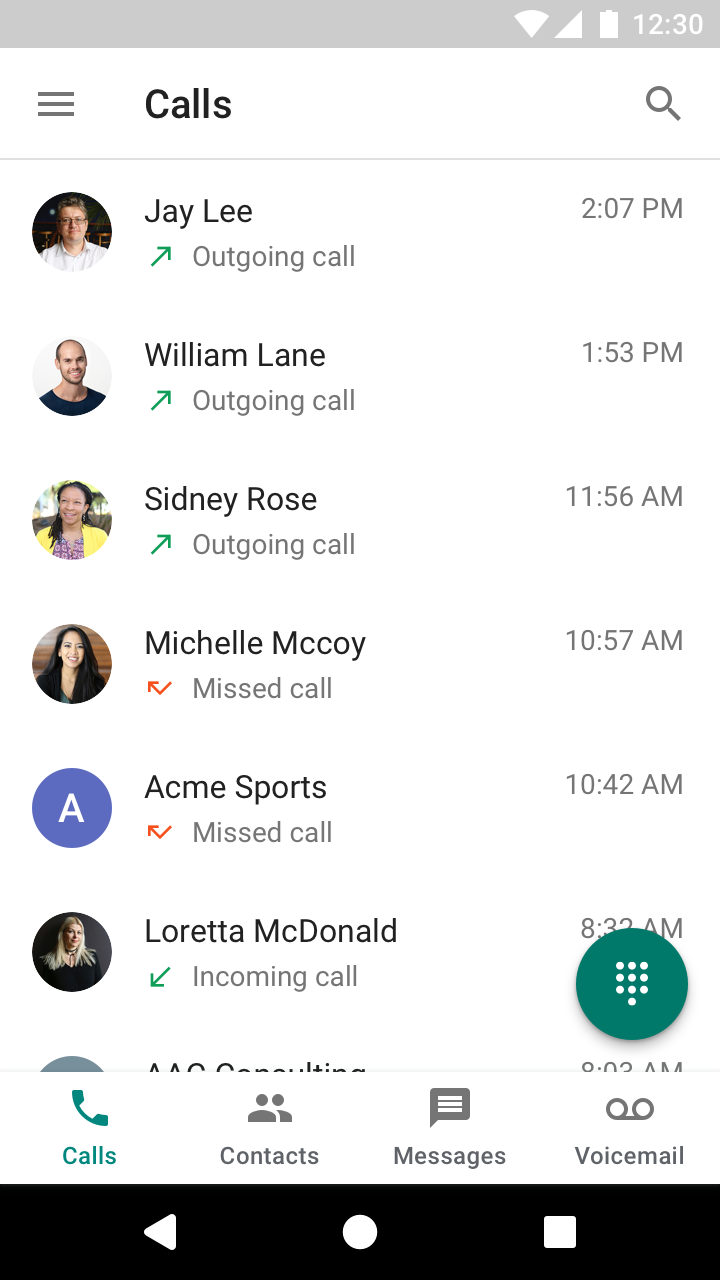
Google today said it will be rolling out an enterprise version of its Google Voice service for G Suite users, potentially tapping a new demand source for Google that could help attract a whole host of new users.

Google voice has been a long-enjoyed service for everyday consumers, and offers a lot of benefits beyond just having a normal phone number. The enterprise version of Google Voice appears to give companies a way to offer those kinds of tools, including AI-powered parts of it like voicemail transcription, that employees may be already using and potentially skirting the guidelines of a company. Administrators can provision and port phone numbers, get detailed reports and set up call routing functionality. They can also deploy phone numbers to departments or employees, giving them a sort of universal number that isn’t tied to a device — and making it easier to get in touch with someone where necessary.

All of this is an effort to spread adoption of G Suite among larger enterprises as it offers a nice consistent business for Google. While its advertising business continues to grow, the company is investing in cloud products as another revenue stream. That division offers a lot of overhead while Google figures out where the actual total market capture of its advertising is and starts to work on other projects like its hardware, Google Home, and others.

While Google didn’t explicitly talk about it ahead of the conference today, there’s another potential opportunity for something like this: call centers. An enterprise version of Google Voice could give companies a way to provision out certain phone numbers to employees to handle customer service requests and get a lot of information about those calls. Google yesterday announced that it was rolling out a more robust set of call center tools that lean on its expertise in machine learning and artificial intelligence, and getting control of the actual numbers that those calls take in is one part of that equation.

There’s also a spam filtering feature, which will probably be useful in handling waves of robo-calls for various purposes. It’s another product that Google is porting over to its enterprise customers with a bit better controls for CTOs and CIOs after years of understanding how normal consumers are using it and having an opportunity to rigorously test parts of the product. That time also gives Google an opportunity to thoroughly research the gaps in the product that enterprise customers might need in order to sell them on the product.

Google Voice enterprise is going to be available as an early adopter product.